Offside Rule Explained: Position, Involvement and Six Clear Examples
The offside rule is easier to follow if you freeze the move at the relevant touch, then watch what the attacker does next. Being ahead of a defender is only part of the question. The ball, the second-last opponent and the attacker’s involvement all matter.
Reviewed: 13 October 2026 against Law 11, 2026/27. The situations below are invented teaching examples. They explain the normal law rather than claim to overturn a decision from a particular match. Competition technology and trial arrangements should be checked separately.
The offside position test
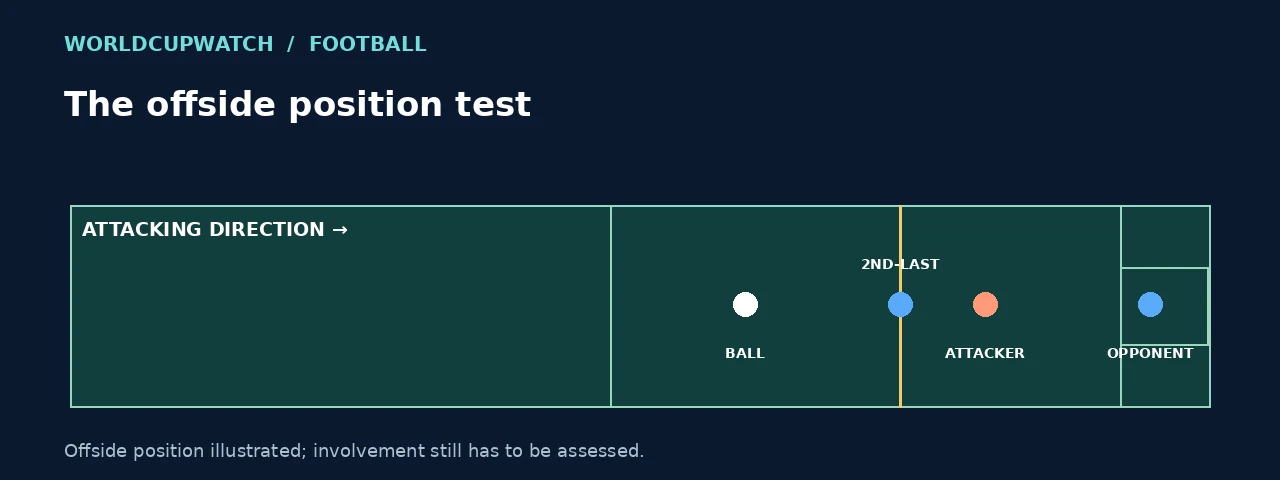
An attacker is in an offside position when a relevant part of their head, body or feet is in the opponents’ half and closer to the opponents’ goal line than both the ball and the second-last opponent. Hands and arms are excluded. A player level with the second-last opponent is onside.
Position alone is not an offence. The player must become involved in active play in one of the ways covered by the law. The usual reference is the first contact when a teammate plays or touches the ball; for a goalkeeper’s throw, the law uses the release contact.
Count opponents, not just defenders wearing an outfield shirt. A goalkeeper often occupies the last position, but does not have to. If the goalkeeper has advanced, another opponent may define one of the relevant positions. Looking only for the last center-back can therefore produce a mistaken reading.
For a first viewing, identify three things in the freeze-frame: the direction of attack, the ball and the second-last opponent. Then identify the attacker you are judging. This gives you a useful picture before you consider the action that follows.
Six invented examples: what to look for
1. A through ball and a late run
A midfielder prepares a pass while a striker waits level with the second-last opponent. The striker then accelerates and reaches the ball several meters beyond the defensive line. The later receiving position does not, by itself, establish an offence. Judge the striker at the relevant touch of the pass. The quality of the timed run is why the attacker can finish far beyond the defenders without having started in an offside position.
2. A striker runs back towards the ball
A striker begins beyond the relevant line and comes back to collect a teammate’s pass. Looking only at the collection can make the striker appear safely in front of the defense. The earlier touch still matters. Returning towards the ball is not a shortcut for ignoring where the striker was when that phase began.
3. A square pass near goal
Two attackers break beyond the remaining opponents. One carries the ball and passes to a partner who stays behind the ball’s position. Compare the partner with the ball as well as the opponents. The familiar instruction to “stay behind the ball” helps explain this move, but the actual direction and timing must still be checked rather than assumed from a camera angle.
4. A teammate leaves the ball alone
A pass travels towards two attackers. One is beyond the relevant line but takes no part in the move; the other controls the ball from an onside position. Follow the involvement rather than treating every advanced player as automatically punishable. If the first attacker later receives a new pass, judge the new phase at its own relevant touch.
5. A shot with an attacker near the goalkeeper
A forward does not touch a teammate’s shot but stands in a position that may affect the goalkeeper’s view or ability to play. The absence of a touch does not settle the incident. The officials must assess the player’s actual effect on the opponent. A freeze-frame establishes location, while the moving sequence helps establish involvement.
6. A ball comes back after a save
A teammate shoots, the goalkeeper saves, and the rebound reaches another attacker. Start the review with the attacker’s position when the shot was taken. A rebound or save is not automatically a fresh phase that makes every advanced attacker eligible to play. This is why the original shot remains relevant to a tap-in from the rebound.
These scenarios are a viewing exercise. They do not include every condition or exceptional incident in Law 11. For a disputed real decision, check the complete sequence and the officials’ explanation rather than match the clip to one isolated sentence.
Deliberate play, deflections and the restart exceptions
A defender’s deliberate play can change the assessment; a mere deflection or deliberate save is treated differently. The distinction depends on control and opportunity to play the ball. A poor attempted clearance can still be deliberate play. The fact that the ball touches an opponent is not enough to settle the issue.
There is no offside offence on receiving directly from a goal kick, throw-in or corner. The exemption concerns the direct reception. A later teammate touch creates a new assessment. An ordinary free kick does not share that same blanket exemption.
When an offence is penalized, the restart is an indirect free kick where the offence occurs under the law. It is not automatically a yellow card. Other misconduct or fouls may need a separate assessment.
For a viewing example, imagine a corner reaches a teammate who passes it straight back to the corner taker. You should not stop thinking at the words “corner kick.” The return pass is another action. Follow each touch in sequence and ask which phase is now being assessed.
What VAR and offside technology contribute
FIFA describes semi-automated offside technology as support for match officials. Player tracking and the identification of the relevant ball contact help establish position. Officials still assess incidents that involve interpretation, including interference with an opponent.
The FIFA connected-ball explanation describes the role of identifying the kick point alongside player tracking. A technology animation helps viewers see a position decision, but it should be understood together with the relevant phase and the human decision process.
A television still can be misleading if it freezes the wrong moment. A high camera angle can also make depth hard to judge. Instead of drawing your own line from a compressed social video, look for the broadcast’s relevant contact, its selected body point and the explanation of what the attacker did.
Do not assume that every league, international or grassroots match has identical equipment. The law and the technology used to support its application are separate questions. A match without VAR still has offside decisions, and a match with VAR still requires officials to apply the law.
A useful checklist for the next replay
Start with the direction of attack. Locate the relevant teammate touch. Compare the attacker with the ball and second-last opponent at that moment. Then watch the attacker’s involvement and any opponent action before deciding whether the apparent position becomes an offence.
For teaching, pause a replay twice: once at the pass, and again when the receiver becomes involved. The first pause helps with position; the second helps with what actually happens. If you only pause when the goal is scored, you may miss the moment that defines the incident.
When discussing a decision, identify what is disputed. Is it the contact moment, the relevant body point, the opponent count or interference? Those are different disagreements. Stating the specific question is more useful than arguing that an attacker “looks miles offside” in a later frame.
Questions and related football reading
Can a player be beyond the defense and still be onside? Yes, the ball’s position also matters, and the relevant moment may precede the receiving position shown in a highlight.
Is every advanced player punished? No. Position and involvement are distinct parts of the assessment.
Does any defender touch reset offside? No. Deliberate play, deflection and save must be distinguished under the law.
Does an arm make a player offside? Hands and arms are excluded from the position test. The law specifies the relevant body boundary.
- Football hub connects our football analysis, reference pages and news.
- FIFA rankings October 2026 explains the latest checked international ranking changes.
- World Cup 2026 bracket records the completed knockout pathway.
- World Cup replays and highlights provides source and territory checks for revisiting tournament decisions.
Law review: The IFAB Law 11, 2026/27. Technology sources: the two official FIFA resources linked above. Our Editorial Policy explains how corrections are handled; readers can use the contact page.