DLS Method Explained: Par Score, Revised Targets and Rain Rules
The DLS method can turn a rain interruption into the most misunderstood moment of a cricket match. One team has scored more runs, the other has faced fewer balls, and a television graphic suddenly shows a new target. The key is to separate three things: batting resources, the score needed to be level at a stoppage, and the target needed to win if play continues.
Checked: 13 October 2026. This is a spectator’s explanation of Duckworth–Lewis–Stern, supported by ICC resources and the relevant limited-overs playing conditions. It is not an official DLS calculator. All numerical match situations below are invented, and any supplied par score is an assumption for teaching rather than a value calculated from ICC software.
What the DLS method does
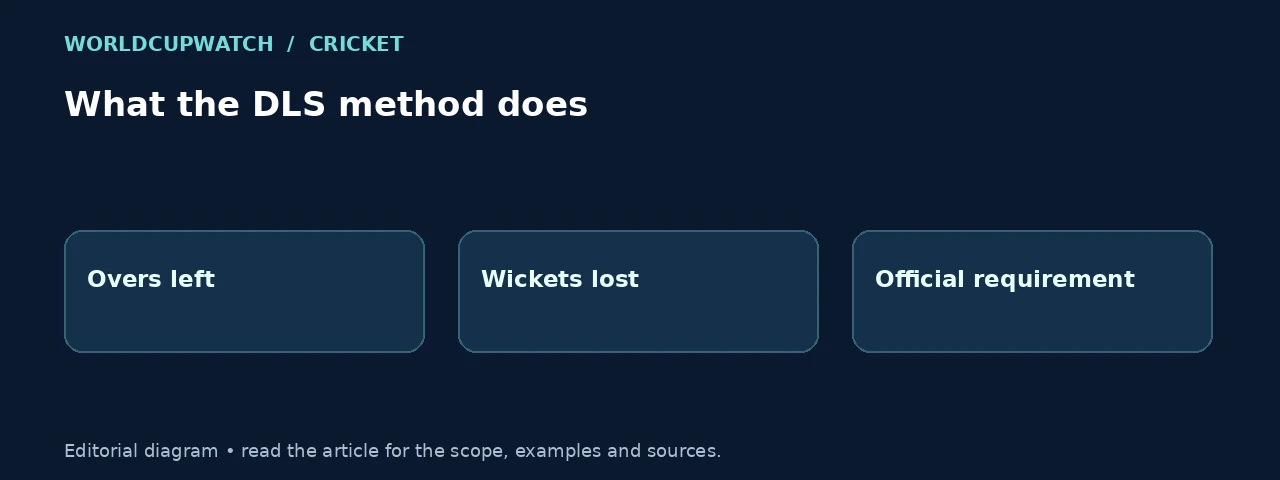
DLS adjusts the requirement in a limited-overs match when an interruption changes the batting opportunities available to either side. It considers overs remaining and wickets lost. Those two inputs represent different parts of a team’s remaining ability to score: time to face deliveries and batters still available to use them.
It is tempting to say that twenty overs should produce exactly twice as many runs as ten. Cricket does not work that way. A team expecting twenty overs can plan its opening differently from a team that knows before batting that it has only ten. Likewise, losing three overs with nine wickets in hand is different from losing three overs with only one wicket left.
The first batting side is commonly described as Team 1 and the chasing side as Team 2. Rain can affect either innings, the interval between them, or both. An adjustment does not necessarily reduce the target: if the relative resources favor the chasing side, the requirement can rise. The event sequence determines the calculation.
The ICC’s DLS resource links its methodology and related documents. The methodology distinguishes the professional Stern calculation used with ICC software from the older Standard Edition described in publicly available tables. A familiar textbook formula should not be presented as a replacement for the current official calculation.
For a viewer, the practical question is not whether you can reproduce the complete model during an interruption. It is whether you can identify the official new requirement and read it correctly. Once the officials announce a target, the batting team still has a straightforward task: reach that target within the revised innings allocation while keeping enough batters available.
Why wickets matter as well as overs

Imagine two invented chases stop after twelve overs at 90 runs. Team A has lost one wicket; Team B has lost seven. Their totals and elapsed overs match, but the batting resources left do not. A simple average-run-rate comparison would treat them alike. A resource-based method is designed to account for the difference.
That does not mean a particular wicket always adds a fixed number of runs to a par score. The impact depends on the match state and the applicable model. A social post claiming that every wicket costs ten DLS runs is replacing the calculation with a rule of thumb. It may fail precisely in the close matches where accuracy matters most.
The timing of a rain delay matters too. A side that loses overs after preparing for a longer innings may have spent deliveries building a platform. The opponent might begin knowing the shorter allocation from its first ball. Treating those experiences as identical can hide the opportunity lost by the first team.
Consider a teaching situation in which a captain expects a fifty-over innings, but the match is shortened after twenty overs. The batting side cannot go back and change how cautiously it used its first twenty. The revised requirement is intended to account for the changed resources, rather than judge that team as if it had always known the innings would be shorter.
This is also why a late burst of boundaries does not make the model unnecessary. The actual first-innings total remains central, but the relative opportunities must still be considered. DLS sets an adjusted contest; it does not decide which batting style was aesthetically better or which team deserves sympathy for the weather.
Par score and target are different numbers
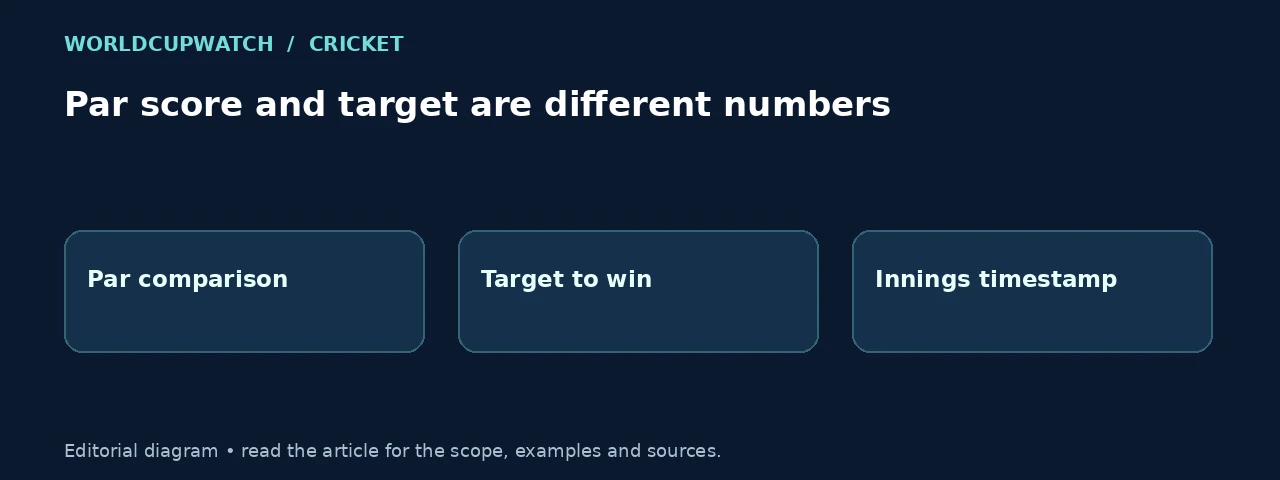
An official par score is the score with which the chasing team’s total is compared if the match ends at that particular stage under the applicable rain-result conditions. A target is the score it needs to reach to win an innings that continues or resumes with a revised allocation. Mixing the two creates the familiar one-run misunderstanding.
Suppose, purely for illustration, that the announced par at a stoppage is 112. If the match is validly terminated at that stage and the chasing side has 113, it is one run above par. If it has 112, it is level. If it has 111, it is one below. The actual result still depends on the officials’ confirmation and the competition’s conditions.
Now suppose the officials announce a resumed chase with a winning target of 113. The batting team must reach 113 to win. Finishing on 112 at the end of the revised innings is not a victory simply because a separate graphic earlier described 112 as par. Read the label, the timestamp and whether play is continuing.
| Invented official par at termination | Chasing total | Comparison |
|---|---|---|
| 112 | 113 | One above par |
| 112 | 112 | Level with par |
| 112 | 111 | One below par |
These values are deliberately supplied, not computed from a resource table. They teach how to interpret an announced requirement. You cannot use them to infer what the par would be at a different over or after another wicket.
When a broadcast shows a moving par line, keep its context attached. A line for 14.0 overs and three wickets is not automatically valid at 14.3 or after a fourth wicket. A screenshot with the score visible but its innings stage cropped out can be technically authentic and still give the wrong impression.
A revised chase: read the equation in balls
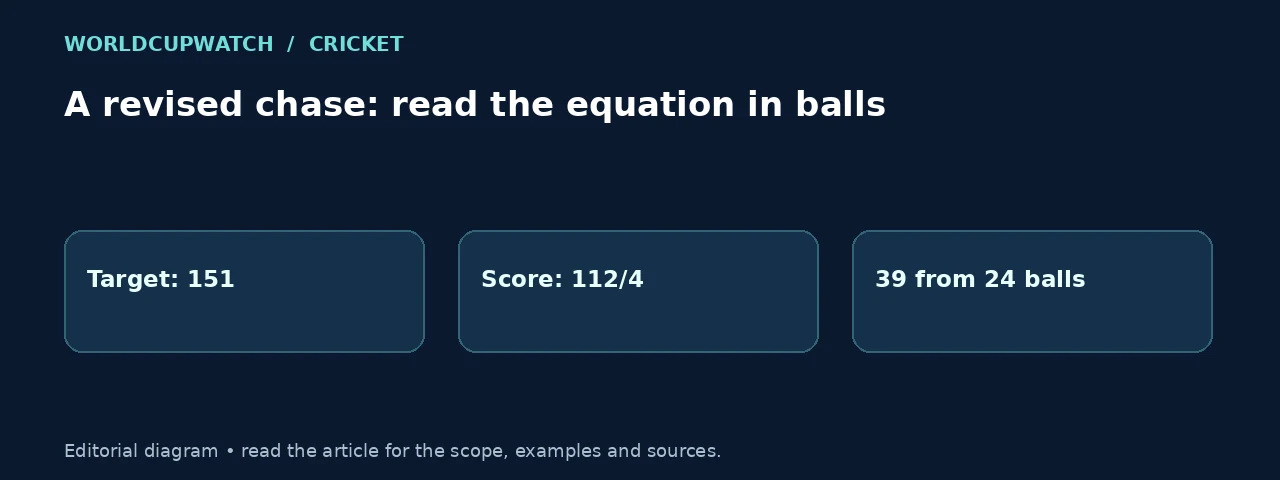
Take another invented example. Team 1 finishes its innings, and after an interruption the officials announce that Team 2 must score 151 in eighteen overs. After fourteen overs the chase is 112/4. The team needs 39 from 24 legal deliveries. That remaining requirement can be calculated directly from the official target without knowing the internal DLS model.
If the next two overs add eighteen runs, the score becomes 130. The team now needs 21 from twelve balls. The target has not changed merely because its required rate changed. Only a further official adjustment, such as another loss of overs, would create a new target in this situation.
Cricket notation is important. At 14.3, the side has faced 87 legal balls, leaving 21 in an eighteen-over innings. Do not treat 14.3 as a decimal. If it has 120 at that point while still chasing 151, it needs 31 from those 21 balls. Counting legal deliveries is the safest way to avoid a misleading required rate.
A wide or no-ball can add to the score while leaving the legal-ball count unchanged. That changes the immediate requirement, but it is an ordinary scoring event, not evidence that the DLS target has secretly shifted. Follow the scorecard’s entry and the official target separately.
The same approach works in a short T20 chase and in an interrupted ODI. Write down the announced target, subtract the current total, and count the remaining legal balls. That gives the practical task facing the batters. It does not predict success, account for the remaining batting quality or replace the officials’ resource calculation.
What changes when rain returns?
A second interruption requires the match history to remain intact. The first adjustment does not erase the earlier loss of overs. Officials need the original allocation and each relevant suspension, resumption, score and wickets state to apply the prescribed calculation correctly.
Imagine a chase first reduced from twenty to eighteen overs and later reduced to fifteen. A fan cannot simply multiply the eighteen-over target by fifteen divided by eighteen. The chase has already used some of its resources, and the number of wickets lost matters. A new requirement must come from the authorized process.
For a viewer or reporter, a small timeline is useful:
- Record the original innings allocation.
- Record the score, wickets and legal balls at each stoppage.
- Record the official revised allocation and target after each resumption.
- If the match ends without resumption, record the official par comparison and result.
That record can resolve a surprising amount of confusion. A graphic from the first delay might still be circulating after a second adjustment. A commentary post may mention the old target without saying it has been superseded. The latest official announcement belongs at the top of a live report; previous values should be labeled as earlier states.
Do not assume that rain automatically activates a reserve day. A reserve day is available only when the competition or series provides one, and its use follows the applicable conditions. Some matches must be resolved, reduced or recorded as no result within their scheduled window.
Minimum overs, early victories and no results

A DLS number alone does not prove that a valid result is available. The innings must satisfy the match’s minimum requirements, unless a permitted earlier conclusion has already occurred. A chase completed early and a chase stopped too early by rain are different situations.
The ordinary men’s ODI and T20I conditions should be read separately, and a tournament can have specific provisions. In the usual ODI framework, the chasing side needs the opportunity for twenty overs unless a result is reached earlier; the usual T20I framework uses five. Check the current competition rules, particularly for knockout matches or designated reserve days.
Suppose an invented side begins a short chase and reaches its authorized target within four overs. That is not the same as four overs being delivered before rain ends an unfinished chase. The first situation can already have a match conclusion; the second may fail the relevant requirement for a rain result. The official result notice settles the distinction.
Weather abandonment is not a drawn Test. In limited-overs cricket, a no result has its own effect on a tournament points table. A tie is another separate outcome. A table may distribute points for a no result, and it may exclude that match from NRR, but the details belong to the competition’s regulations.
If a match looks likely to be abandoned, avoid reporting a winner while officials are still assessing the possibility of play. A side being ahead of a displayed par line is a current match fact, not a guarantee that the contest has legally ended. The required overs and opportunity to resume must also be resolved.
DLS, run rate and NRR: three different jobs

Current run rate describes scoring pace in the innings so far. Required run rate describes the pace needed for the remaining chase. DLS adjusts the requirement after lost batting opportunity. Net run rate is a tournament calculation across the matches counted for a team. They share familiar words but answer different questions.
| Measure | The question it answers |
|---|---|
| Current run rate | How quickly has this innings scored? |
| Required run rate | What scoring pace does the remaining chase need? |
| DLS requirement | What is the authorized rain-adjusted task or par comparison? |
| Net run rate | What is the team’s aggregate tournament scoring-rate balance? |
For an invented chase at 90 after ten overs, the current rate is nine per over. If the side needs 61 from eight further overs, the required rate is 7.625. Neither value alone tells you the official par if rain ends play now. A resource calculation uses more information than these two pace summaries.
NRR in a DLS-affected competition match can involve adjusted totals or overs prescribed by the regulations. Do not reconstruct it by casually dividing the displayed raw scores. Our net run rate calculation guide covers the key adjustments and why averaging individual match NRR values is also unreliable.
When writing a headline, use the official result margin. A completed revised chase can produce a wickets margin; a match terminated during a chase can be described using its difference from par. A rain result should not be labeled with an invented margin obtained by subtracting the two raw team totals.
Can you calculate DLS yourself?
You can calculate the remaining runs and balls from an announced target. You can also learn the resource principle from the ICC’s public material. Reproducing the official professional DLS calculation requires the applicable authorized model, version and inputs; a generic online form is not automatically equivalent.
The historical Standard Edition formula is often used to explain a case in which Team 2 has fewer resources than Team 1. It illustrates a resource ratio rather than an overs ratio. But using invented percentages, an old table or an assumed average score can produce a plausible-looking answer that differs from the professional calculation.
For that reason, this guide does not ask you to enter a score and receive a purported official target. A calculator with the wrong model can be more confusing than an explanation without one, because its neat output hides the missing assumptions. For a real match, use the requirement announced by the officials and the current official scorecard.
A school or club tournament may authorize a particular method. The organizer should tell participating teams which system applies and who supplies the calculations. Agreement before play is more useful than deciding after a rain delay that a convenient online result should govern the match.
For reporters, do not present a private model or unofficial tool as ICC software. Name the method actually used, keep any estimate clearly separate from the official requirement, and correct an earlier figure if the authorized target changes. Readers need to know which number determines the match.
Frequently asked questions and related reading

Can the chasing target rise after rain? Yes. The relative opportunities matter, so a first-innings interruption can leave the second side with more resources. A reduced number of overs does not, by itself, prove that every revised target must be lower.
Does losing a wicket change the par score? The wicket state is an input to the resource assessment. The exact effect is not a universal fixed number, and you should use the current official requirement for the match stage.
Is the highest raw total always the winner? No. A rain-adjusted result compares the appropriate requirement with the chasing score. The two raw totals can represent different opportunities.
Does DLS decide Test results? DLS is a limited-overs adjustment method. Tests use their own result, time and playing-condition framework.
Is a televised par score guaranteed to remain valid? No. Keep the innings stage and wickets state attached, and use a fresh official value after any change.
- Cricket rules explained teaches overs, wickets, extras and scorecard reading before the rain calculations.
- Net run rate calculation shows how tournament NRR differs from a chase’s required rate.
- Cricket World Cup 2027 explains the event pathway and points-table context.
- Pakistan cricket schedule and India cricket schedule keep fixture dates separate from unverified start times.
Official references: ICC DLS methodology and documents and ICC ODI and T20I playing conditions. Report a correction through WorldCupWatch contact.