ICC Playing Conditions October 2026: What Viewers Need to Know
The ICC’s October 2026 playing-condition changes affect how viewers should interpret several familiar moments: a batter delaying play, a disputed fielding action, or a wicket falling late in a Test day. The changes apply to international series starting on 1 October 2026 or later. Ongoing series can continue under the previous conditions.
Reviewed: 13 October 2026. The official ICC announcement supplies the changes and their scope. Practical viewing situations below are WorldCupWatch examples, not reports of individual incidents.
The changes at a glance
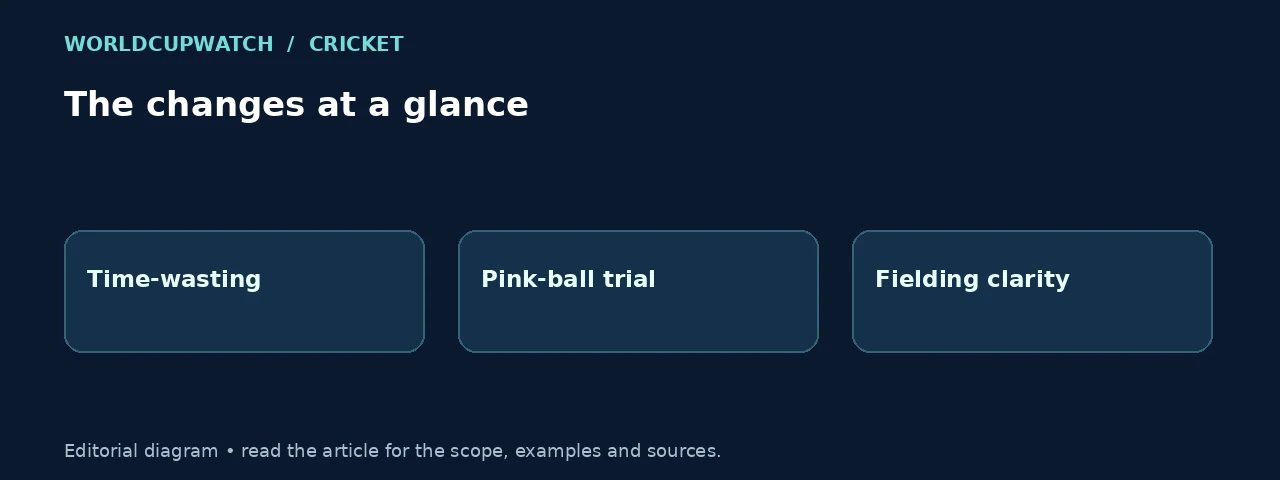
| Area | Key change in the ICC announcement |
|---|---|
| Men’s batter time-wasting | Warning, final warning, then five penalty runs to the fielding side for the third and later offences |
| Daytime Test pink-ball trial | Agreement before the match; the agreed ball applies throughout |
| Test day’s unfinished last over | A wicket does not automatically end the day when conditions permit continuation |
| Fielding | Clarifications cover overthrows, a finally settled ball and control when holding the ball |
| Women’s balls | More distinct size and weight specifications |
The full wording and format-specific conditions remain important. A list of changes is a starting point for understanding an incident, not a substitute for the officials’ application of the rules.
Why the series start date matters
Imagine two Tests taking place in October. One belongs to a series that began in September; the other belongs to a series that began after 1 October. The calendar month of an individual day’s play is not enough to determine the applicable version. Check when the series started and the conditions issued for it.
The same care applies when a domestic-league clip appears beside an international clip. A league can use its own competition provisions. A viewer should first identify the competition, format and version, then assess the decision. Comparing two clips without those labels can manufacture an apparent inconsistency.
Our cricket rules guide now includes the October context. For a close decision, use the ICC current playing-conditions directory to choose the actual format document.
The practical questions to ask during a match
For a time-wasting discussion, ask what warning stage the officials have reached and which readiness requirement applies. A delayed broadcast graphic or a commentator’s first impression may not establish that sequence. Do not report penalty runs until the official decision is clear.
For a pink-ball Test, ask whether the participating teams agreed to the trial before the match. The change is not an instruction to replace a red ball whenever light becomes difficult. The weather and light assessment still belongs to the officials under the applicable conditions.
For a disputed run out or stumping, a useful question is whether the fielder had complete control while holding the ball. For an apparent overthrow, distinguish an attempt directed towards the stumps from an ordinary misfield. The original sequence is more informative than a single frame of the ball contacting a wicket.
Men’s Cricket Committee Chair Sourav Ganguly referred to “measures aimed at improving the pace of the game” in the ICC statement. That short quotation describes part of the purpose; it does not remove the need to read each condition’s scope.
Related explanations and official sources
- Cricket rules explained supplies the wider framework for runs, dismissals, overs and formats.
- DLS method explained covers a separate set of rain-result questions.
- India cricket schedule identifies upcoming white-ball and Test series as separate programmes.
- Pakistan cricket schedule records the announced Pakistan home dates and current source notes.
Sources: ICC announcement, 1 October 2026 and the ICC format-specific conditions effective October 2026. Questions or corrections: WorldCupWatch contact.