
Cricket Rules Explained: A Beginner’s Guide to Scores, Wickets and Formats
Cricket rules become much easier to follow when you start with one question: what does the batting team need to do next? It might need another 15 runs, protect its last pair of batters, or survive until the end of a Test. The score, the wickets and the remaining deliveries tell you which story you are watching.
This guide takes you from your first scorecard to the decisions that can change a match. You will learn how runs and overs work, what counts as a dismissal, why a powerplay changes the field, and how to tell a rain target from a tournament tie-breaker. The examples are invented teaching situations, not reports of real matches.
Rules checked: 13 October 2026. International cricket uses the MCC Laws together with the ICC playing conditions for the relevant format, competition and series. The October 2026 updates apply to international series starting on 1 October or later; an ongoing series can remain under the earlier conditions. Domestic leagues and junior cricket may use different arrangements.
The aim of cricket and the players on the field
Two teams compete to score more runs than each other. A standard international side has eleven players. When a team bats, two of its players occupy the pitch; when it fields, the opposing batters face a bowler supported by a wicketkeeper and other fielders. The captain decides how to use the available bowlers and place the field within the applicable restrictions.
An innings is a team’s turn to bat. In a normal ODI or T20 international, each team has one innings. In a normal Test, each team can have two. That difference changes how you should watch the game. A quick burst of runs can decide a T20; a long defensive partnership can be a valuable achievement in a Test even when the scoreboard moves slowly.
The bowler delivers the ball towards the batter at the striker’s end. The other batter is the non-striker. Batters try to score without being dismissed, while the fielding team tries to limit runs and take wickets. The roles reverse when the next team’s innings begins, although Test cricket can involve declarations and a follow-on rather than a simple alternating sequence.
Think of a limited-overs innings as two budgets being used at once. One is the number of legal balls left; the other is the number of wickets available. A side that has plenty of balls but almost no batters left is in a different position from a side with several wickets in hand and only two overs remaining. That is why an isolated total never tells the whole story.
For example, imagine two teams both reach 140 after 16 overs in a T20. One is 140/2; the other is 140/8. They have the same total and the same number of balls left, but the first team can usually plan its last four overs with more batting options. This is a useful way to begin thinking about resources without pretending to predict the final score.
The pitch is the strip between the wickets, while the ground includes the surrounding outfield. A fielder standing near the batter has a different job from one stationed near the boundary. You do not need to memorize every position before enjoying a match. Start by noticing whether fielders are close enough to try for catches or deep enough to prevent boundaries.
How runs, boundaries and extras are scored
Batters can score by running between the wickets. When they safely exchange ends, one completed run is added. They can attempt further runs if the ball remains live, but each attempt brings a risk of being run out. The decision depends on where the ball is, the fielder’s recovery, the speed of the runners and their communication.
A boundary generally contributes four runs if the ball reaches the boundary after touching the ground, or six if a ball struck by the bat clears the boundary without first grounding inside the field. Unusual incidents, including overthrows and fielders contacting the boundary while handling the ball, require the relevant law rather than a shortcut based on what a television angle seems to show.
The team’s total can also grow through extras. Wides and no-balls normally add a penalty run and do not count as one of the six legal balls in an over. Byes and leg-byes are recorded separately from the batter’s own runs. Penalty runs can also be awarded under the playing conditions. Not every run on the team scoreboard belongs to an individual batter.
Here is a simple scoring exercise. An invented over contains a dot ball, a single, a four, two runs, another dot and a single. The batting team adds eight runs from six legal deliveries. If an additional wide is delivered before the final legal ball, the team adds the wide penalty too, and the over still needs its sixth legal delivery. This is why an over can contain more than six actual deliveries.
A dot ball means no run is scored from that delivery. It may be a victory for the bowler, but its value depends on the match. Three consecutive dots at the start of a Test innings are routine. Three dots when a T20 chase needs ten runs from the final six balls can transform the contest. Watch the requirement before deciding how damaging a dot really is.
Batting totals and team totals should be kept separate when reading a scorecard. If the listed batters have 164 runs between them and extras contribute 12, the team total is 176. An extras line is not an error or an additional batter. It records the scoring that is not credited to the batters in the ordinary way.
Running also changes who faces the next ball. On an ordinary completed single or three, the batters exchange ends. After an over, the bowling end changes. A batter can therefore keep or give away the strike through the combination of the runs taken and the end of the over. This small detail often explains an important late-innings decision.
Overs, legal balls and the cricket scorecard
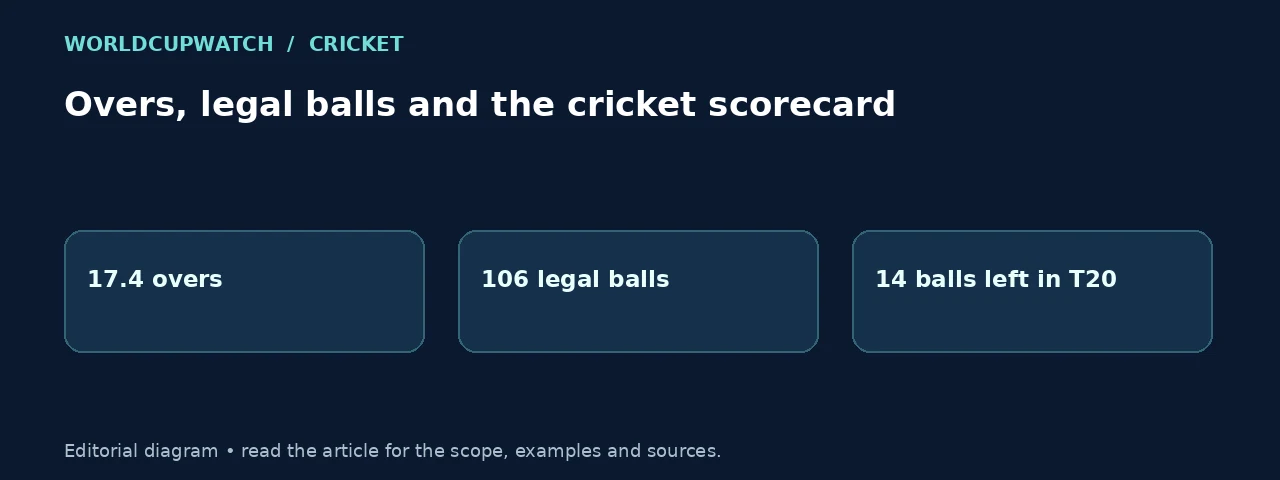
An over normally contains six legal deliveries. Cricket notation records complete overs and then the additional legal balls. 17.4 overs means 17 overs and four balls: 106 legal deliveries. It does not mean 17.4 in decimal arithmetic. Dividing 106 by six gives the decimal equivalent if a calculation needs one.
For a full 20-over innings, there are 120 legal balls. After 17.4, fourteen legal balls remain. A casual reader might subtract 17.4 from 20 and get 2.6, but that is not valid cricket notation. Count the completed balls instead: 120 minus 106 equals 14. The next two deliveries complete the eighteenth over, followed by two full overs.
A score such as 156/4 means the team has 156 runs and has lost four wickets. It does not mean four batters remain. Under the usual eleven-player arrangement, six wickets remain available before the side is all out. The two current batters and the players yet to bat have different roles in that remaining batting resource.
Some scorecards reverse the presentation and display wickets before runs. Always read the column labels, especially when switching between providers. A score graphic without an innings number can also be misleading during a Test. A team’s first-innings 250 and its second-innings 250 belong to different stages of the match, even if the numbers look identical.
Batting columns commonly include runs, balls faced, fours, sixes and strike rate. Strike rate expresses runs per hundred balls faced. An invented batter with 36 from 24 balls has a strike rate of 150: 36 divided by 24, multiplied by 100. That does not mean the batter has scored 150 runs or that the next hundred balls will produce 150.
Bowling figures often appear as overs, maidens, runs conceded and wickets. A figure of 4–0–28–2 describes four overs, no maidens, 28 runs conceded and two wickets. A maiden is an over with no runs charged to the bowler under the scoring rules. The team extras line and bowler’s conceded runs do not always increase in the same way.
Economy rate is the runs charged to a bowler per over. In the example above, 28 divided by four equals 7.00. If the spell ends after 3.2 overs, use twenty legal balls, equivalent to three and one-third overs. Treating 3.2 as a decimal can produce the wrong result. The same ball-counting issue matters in net run rate calculation.
Wickets and the dismissals you will see most often
Bowled, caught, leg before wicket, run out and stumped are among the dismissals a new viewer will encounter most often. The word wicket can describe the physical set of stumps and bails, the dismissal of a batter, or the surface in a casual discussion. The scorecard usually uses it to count dismissals.
For a bowled dismissal, the delivery breaks the striker’s wicket under the rules. A caught dismissal requires a legally completed catch after the ball touches the bat, including a hand or glove holding it, before the ball touches the ground. Control of the ball and the fielder’s movement matter; a dramatic first touch alone does not complete every catch.
Leg before wicket, usually called LBW, involves a sequence of conditions. The ball’s pitching point, the point of impact, whether the batter offered a shot and the projected path towards the stumps can all matter. A ball hitting a pad is not automatically out. Conversely, an LBW decision is not limited to the pad: the law concerns interception by the batter’s person under its specified conditions.
A run out concerns a batter being out of their ground when the wicket is fairly broken while the ball is in play, subject to the law’s exceptions. Stumping has a more specific set of circumstances involving the striker, wicketkeeper and absence of an attempted run. They can look similar on a highlight clip, so a scorecard’s official dismissal description is useful.
Less frequent dismissals include hit wicket, obstructing the field, hitting the ball twice and timed out. A retirement can also require careful reading of the scorecard. Do not classify every departure from the field as a bowler’s wicket. A batter leaving because of injury and a batter dismissed by a delivery are not the same event.
Imagine a batter finishes on 64 not out while their partner is run out attempting a second run. The bowler has helped create pressure, but a run out is not credited as a wicket to the bowler. That distinction explains why the team’s wickets column may show a dismissal that is absent from an individual bowler’s figures.
Watch the sequence when a boundary catch is checked. Did the ball touch the ground? Did the fielder touch the boundary while in contact with it? Was the catch completed fairly? Slowing down the replay helps, but the official decision still depends on all the relevant conditions. An attractive still image rarely answers the whole question.
No-balls, wides, free hits and dead balls

A no-ball and a wide are different calls. A no-ball can arise from an illegal delivery or another infringement covered by the playing conditions. A wide concerns a delivery outside the striker’s reach under the applicable definition. The format, batter movement and current conditions can affect how the umpire judges a delivery.
In ODI and T20I cricket, a no-ball is normally followed by a free hit. A free hit restricts the ways in which the striker can be dismissed; it does not remove every possibility of a dismissal. A run out, for example, can still matter. If the free-hit delivery is itself a wide or a no-ball, the free-hit situation continues to the next delivery under the conditions.
The no-ball call takes precedence over a wide. It is therefore wrong to add two separate one-run penalties simply because a delivery appears both illegal and too wide. Additional runs from the play may still be added under the scoring rules. This is another reason to use the scorecard’s delivery entry rather than guess from a commentator’s first reaction.
A ball being called dead means the active play associated with it has ended under the law or an umpire’s call. It does not simply mean that a batter chose not to run. The precise timing can decide whether a later action counts. A run attempted before play has ended is different from players casually returning to position after it has ended.
For series using the October 2026 conditions, the ICC has clarified the assessment of a ball being finally settled and of a fielder holding the ball when breaking the wicket. Complete control is relevant; briefly touching the ball while it contacts the stumps is not automatically the same as holding it. Read the ICC playing conditions for the full wording.
For a teaching example, imagine a chase needs two from one legal delivery. The bowler sends down a wide. The team now needs one, and the legal delivery still remains. If the next ball is a no-ball, the penalty can itself take the team to its target. The result follows the actual scoring sequence; it is not necessary for the batter to hit a winning boundary.
Do not apply the free-hit rule automatically to Test cricket or to every local tournament. A rule you learned during a T20 league may be a playing condition for that competition rather than a universal law. Before arguing about an unusual decision, identify the format and which set of conditions the match is using.
Powerplays, field placements and bowling limits
A powerplay is a period with tighter restrictions on where fielders may stand. In a normal full men’s T20I, the opening six overs permit at most two fielders outside the thirty-yard restriction area; afterwards, the limit is generally five. A reduced match can have a shortened powerplay allocation, so the six-over rule should not be copied unchanged into every rain-affected game.
For a full men’s ODI, the normal outside-fielding limits are two for overs 1–10, four for overs 11–40 and five for overs 41–50. Women’s ODI conditions have their own provisions and should be checked separately. Additional fielding restrictions also apply; counting only the boundary fielders does not settle every legality question.
A bowler normally has a maximum of four overs in a full T20I or ten in a full ODI. A reduced innings changes the permitted distribution. Test cricket does not use that limited-overs quota. These differences help explain why a captain can bring a leading Test bowler back repeatedly but must ration their overs in a short chase.
For viewers, field placement is easiest to understand as a choice between protecting space and creating chances. A close catcher may help dismiss a batter but leave a gap for scoring. A deep fielder may turn a four into a single but offer less pressure near the bat. The captain has to balance those choices against the match requirement.
Imagine an invented T20 team reaches the final five overs needing 48 with seven wickets available. The captain of the fielding side has two overs left from the main strike bowler. Using both immediately may create wickets now, but leaves other bowlers for the last over. Holding one back preserves a later option. There is no universal answer without the players, conditions and current match situation.
The batting side also makes trade-offs. A boundary-heavy powerplay can help, but losing several wickets changes the options for the middle overs. A team that starts slowly is not necessarily beaten, and a team that starts quickly is not guaranteed a large total. Compare the runs and wickets together before labeling a powerplay successful.
Fielding restrictions are one reason sixes and fours have different tactical value from singles, but singles still matter. They rotate strike and make the bowler reset plans. A batter who scores five singles while their partner hits a boundary has helped sustain the innings, even if a highlights package shows only the boundary.
T20, ODI and Test cricket: what changes between formats?
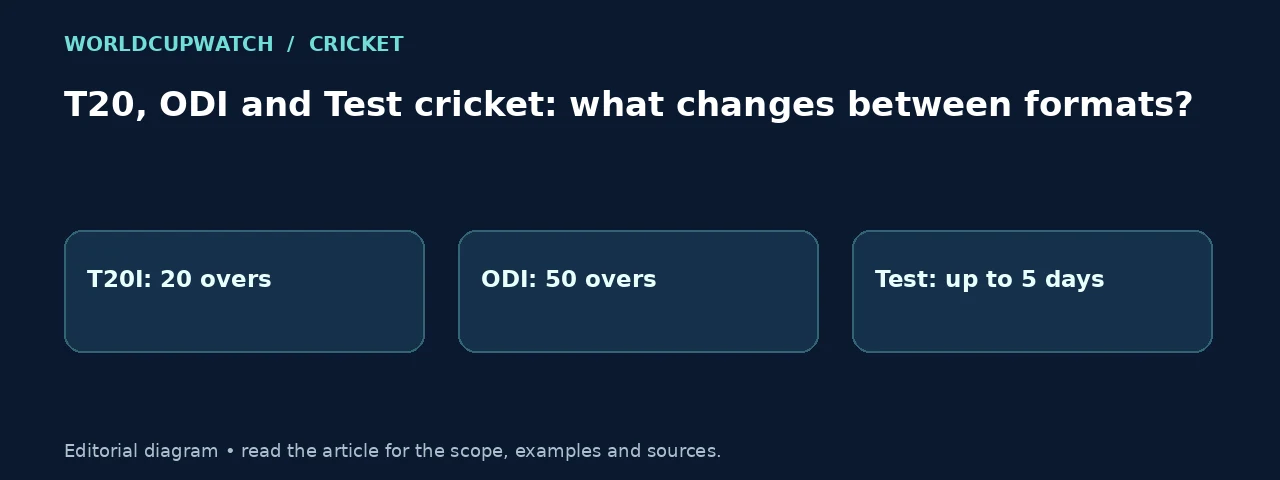
T20 internationals normally provide twenty overs per side; ODIs normally provide fifty. Tests generally run for up to five scheduled days, with each side able to bat twice. Weather, playing conditions and the state of the match can change how much play actually occurs. A five-day listing does not guarantee that a Test will last five days.
| Feature | T20I | ODI | Test |
|---|---|---|---|
| Normal innings per team | One | One | Up to two |
| Normal overs per innings | Twenty | Fifty | No limited-overs innings allocation |
| Common way to read the contest | Runs needed and balls left | Target, wickets and remaining overs | Innings totals, lead, time and wickets |
| Can a normal result be a draw? | A no-result or tie is distinct | A no-result or tie is distinct | Yes |
| Rain adjustment | Applicable limited-overs conditions | Applicable limited-overs conditions | Lost playing time and Test conditions |
In a limited-overs chase, the second team normally needs one more run than the first team’s total. If the first team scores 180, the target is 181. The required run rate tells you the scoring pace needed over the remaining deliveries. It does not account for every tactical factor, especially wickets lost and the quality of the remaining batters.
Test cricket requires a wider view. Suppose Team A scores 310 and Team B replies with 270. Team A leads by forty before beginning its second innings. If it then declares at 220, Team B’s target is 261: the forty-run first-innings lead plus 220 plus one. These invented numbers demonstrate the calculation; they are not a real scorecard.
A declaration ends an innings voluntarily. A captain can use it to leave enough time to dismiss the opponent, accepting the possibility that the target may be chased. A follow-on can require the team behind to bat again immediately if the relevant lead and conditions are met. Neither situation should be confused with a side being bowled out.
A drawn Test means the match finishes without either side achieving the winning conditions, even if one team appears well ahead. A tied Test is different: the scores are equal in the circumstances required by the law. A rain-affected ODI recorded as no result is also different from a draw in a Test. Use the official result term.
The schedule matters too. A Test’s final scheduled day may never arrive if the match finishes earlier. An ODI can begin in the afternoon and end after dark. A T20 often has a short interval, but start times and broadcast arrangements vary. Check the specific Pakistan schedule or India schedule rather than assuming that every match begins at the same hour.
Targets, ties, rain and tournament points

A target tells the chasing team what it needs to win the match. Tournament points tell you how that result affects a larger competition. They answer different questions. A team can win a match yet remain below another team in the table; a side can lose its final group match and still qualify because of earlier results.
Rain can change the number of overs available and, when the applicable conditions require it, the target. The DLS method accounts for batting resources rather than simply multiplying the first innings’ run rate by the second team’s new number of overs. An official par score is also different from a target to win.
Do not decide a rain result merely by comparing totals. If one team has 170 and another has 120, that does not prove the first team has won when the chase has been interrupted. You need the official revised requirement, the exact stage of the innings and confirmation that the match has met its minimum conditions for a result.
A tie may lead to a Super Over or another prescribed procedure in a competition that uses one. It is not safe to assume that every tied limited-overs match follows identical regulations. Reserve days, repeated Super Overs and what happens if further play is impossible belong to the competition’s conditions, not to a universal television convention.
Net run rate, often called NRR, is a tournament measure comparing a team’s aggregate scoring rate with the rate conceded in the matches counted by that competition. It is not the same as the required run rate during a chase. NRR also has special handling for all-out innings and rain-adjusted results. Our worked NRR guide explains those distinctions.
Test championship standings use a different framework. The World Test Championship uses points and the percentage of available points earned, with relevant deductions. It does not rank teams by ODI net run rate. Our WTC points table guide explains how to read that table without mixing formats.
An invented group table shows why the distinction matters. Two teams may finish with the same competition points after different winning margins. The regulations may use NRR to separate them. Before calling a side eliminated, check the actual tie-break order and remaining fixtures. A projected table from a commentator is not the final official table.
Umpires, appeals, DRS and the October 2026 updates
Umpires apply the laws and playing conditions, while scorers record the events and totals. Players can appeal for a dismissal, and some decisions may be referred to the television umpire or reviewed through the Decision Review System where available. Technology assists the decision process; it does not make every decision reviewable in the same way.
DRS can involve ball tracking, evidence of contact and other approved technology. A player review and an umpire referral are different routes. The number of player reviews, the treatment of an umpire’s call and the permitted decisions are specified by the relevant conditions. Avoid importing one tournament’s review allowance into a different series.
For an LBW review, watch the sequence rather than just the final colored boxes. Was there bat contact? Where did the ball pitch? Where was the impact? What is the projected path? A decision can stay with the on-field call under the applicable umpire’s-call rules. That is not necessarily the same as the technology being unable to provide information.
The October 2026 ICC changes are especially useful for viewers returning to cricket. They include a refined men’s batter time-wasting sequence of a warning, a final warning and then five penalty runs to the fielding side for the third and later offences. The exact readiness requirement and match circumstances remain matters for the officials and conditions.
The update also permits a daytime Test pink-ball trial by agreement before the match, clarifies several fielding situations and changes the treatment of a wicket in an unfinished final over of a Test day when conditions remain fit. It does not mean every daytime Test automatically uses a pink ball or that a ball can be swapped mid-match simply because the light deteriorates.
The ICC’s explanation includes the following short statement from Men’s Cricket Committee Chair Sourav Ganguly:
“There are some important changes to the Playing Conditions”
Source: ICC announcement, 1 October 2026. The full announcement provides the scope and exceptions. Read our October playing-conditions explainer for practical examples.
If a clip sparks an argument, first identify when the series began. Then distinguish the ordinary law from the relevant ICC condition and from a competition-specific rule. This approach is more reliable than relying on a rule remembered from an older season, a different league or a cropped social-media video.
Follow a match in five questions
You do not have to memorize the rulebook to follow the next match. Start with five practical questions: which format is this, which innings is being played, how many runs are on the board, how many wickets have fallen, and what is the next requirement? Those questions give you the framework for nearly every scoreboard.
Take an invented T20 chase of 181. After twelve overs, the score is 100/3. The team needs 81 from 48 legal deliveries with seven wickets available. Its required rate is 10.125 runs per over, commonly displayed rounded to two decimals. A graphic showing 10.13 is a rounded pace calculation, not a prediction that the chase will succeed.
Now imagine the next over produces twelve runs but also two wickets. The runs requirement improves, but the batting resource weakens. If you look only at the required rate, you miss half of the story. If you look only at the wickets, you may miss that an established batter is still at the crease. Good match reading combines the two.
At the end of the eighteenth over, suppose the score becomes 166/6. The team needs fifteen from twelve balls. One boundary changes the equation considerably, but a wicket can expose a less experienced partner. A commentator’s claim that the chase is easy or impossible is an opinion until the remaining play settles it.
For a Test, adapt the questions. Which innings is this? Who leads? How many wickets remain? How much playing time is available? Is the batting side pursuing a target or primarily trying to survive? A defensive spell that appears slow on a score graphic may be decisive when a team is trying to draw the game.
Reading highlights requires an extra check: the sequence may be compressed. A video can jump from an early wicket to the final over and omit the partnership that changed the match. Use the complete scorecard for the order of events, and treat the highlights as selected moments rather than a complete explanation of the contest.
Bring the same care to statistics. A high strike rate over six deliveries and a similar strike rate over sixty deliveries tell different stories. A bowler’s economy in the opening powerplay and another’s economy at the death reflect different situations. Rules tell you what happened; context helps you decide what the performance means.
Common questions and related cricket guides
Why are there ten wickets when the team has eleven players? Two batters are normally needed for the innings to continue. Once ten have been dismissed, the remaining player has no available partner in the usual arrangement. Exceptional circumstances involving absent or retired players require the scorecard and rules to be checked.
Can a team win without batting all its overs? Yes. A chasing team wins when it reaches the applicable target; it does not need to complete the full allocation. A team batting first can be all out before its allocation ends. The overs listed for the innings do not guarantee that all of them will be used.
Does 19.5 mean there is half an over remaining? No. It means nineteen overs and five legal balls have been delivered. In a full twenty-over innings, one legal ball remains. Keep cricket notation separate from decimal arithmetic, especially when calculating economy or NRR.
Are domestic leagues identical to international cricket? The basic game is recognizable, but substitution provisions, review allowances, tie procedures, fielding conditions and other arrangements can differ. Identify the competition before applying a remembered rule.
Where should a new viewer go next? Choose the problem you want to solve:
- Net run rate calculation walks through the formula, legal-ball conversion and tournament adjustments.
- DLS method explained separates par scores, winning targets and official rain calculations.
- Pakistan cricket schedule lists the selected senior men’s home programme with source and time-zone notes.
- India cricket schedule organizes verified upcoming senior men’s fixtures without guessing first-ball times.
- Cricket World Cup 2027 connects the format, qualification, groups and fan-planning questions.
- ICC rankings explained distinguishes team ratings, player ratings and championship tables.
For the official rules, use the ICC format-specific playing conditions, the ICC DRS resource, and the ICC DLS resource. Corrections can be sent through our contact page; our Editorial Policy describes our source standards.