
Football
WORLDCUPWATCH · FOOTBALL
Football News & Guides
Football news, club stories, transfer developments and international football. Start with your competition, or explore FIFA World Cup 2026.

Explore football
Every competition. Every angle. Choose the coverage you want.


TOURNAMENT SPOTLIGHT
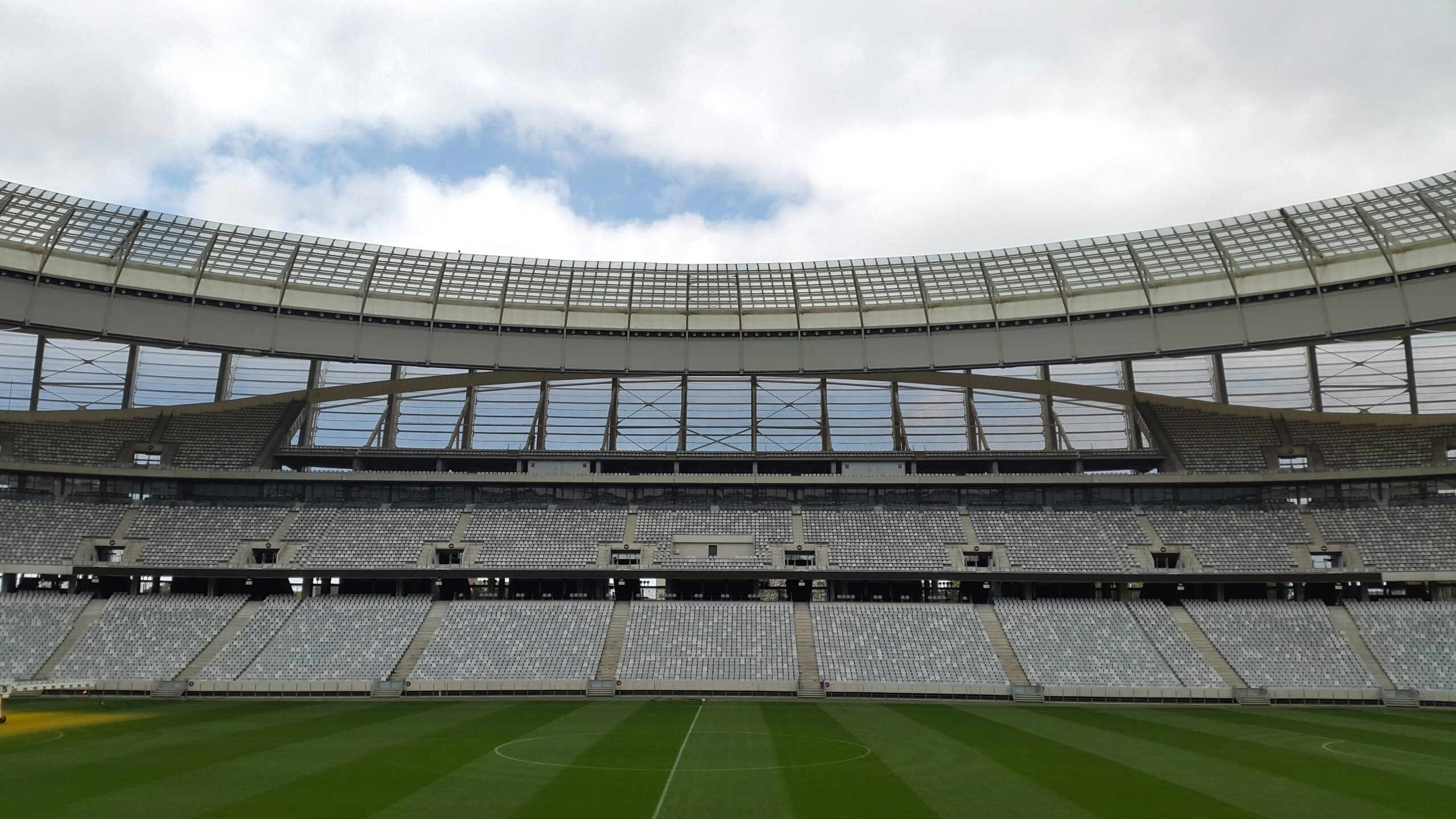
FIFA World Cup 2026
Explore the tournament through its teams, group tables, knockout rounds and top scorers.
Results archive
Browse match results and tournament reports.
Knockout bracket
Follow the route through the knockout rounds.
Final report
Read the coverage of the tournament’s final.
World Cup 2026 stories

World Cup 2026 Awards: Rodri, Mbappe and Messi Explained
Read article →: World Cup 2026 Awards: Rodri, Mbappe and Messi ExplainedSo that is that. The 2026 World Cup is done, the confetti in New Jersey has long been swept up, and the…

FIFA Opens Investigation Into Ugly Scenes After the World Cup 2026 Final
Read article →: FIFA Opens Investigation Into Ugly Scenes After the World Cup 2026 FinalThe celebrations after Spain’s World Cup 2026 final win turned ugly, and FIFA has appointed a prosecutor to investigate. Here is what…
From a Bathtub in 2007 to the World Cup Final: The Messi and Yamal Moment That Broke the Internet
Read article →: From a Bathtub in 2007 to the World Cup Final: The Messi and Yamal Moment That Broke the InternetNineteen years after a charity photo of Messi bathing baby Lamine Yamal, the two met in the World Cup 2026 final. What…


Latest football

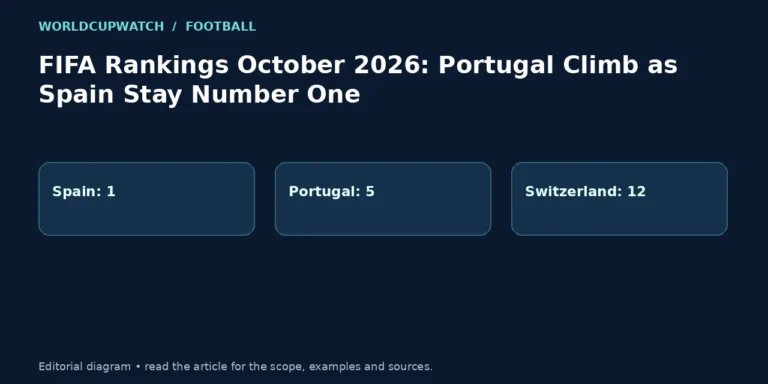
FIFA Rankings October 2026: Portugal Climb as Spain Stay Number One
Read article →: FIFA Rankings October 2026: Portugal Climb as Spain Stay Number OneFIFA rankings October 2026: Portugal rise to fifth, Spain remain number one, and Switzerland move up. Confirmed changes and analysis.
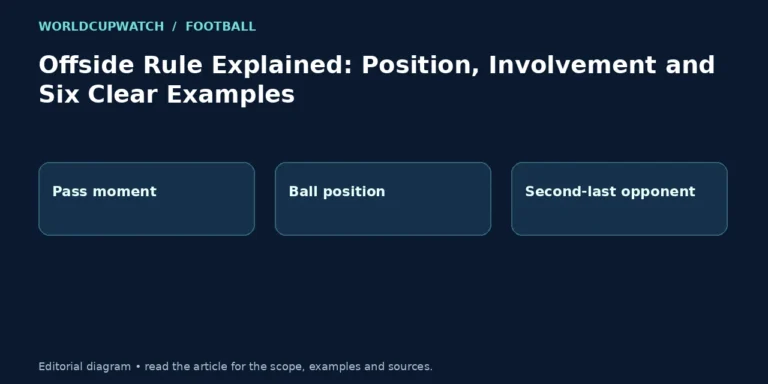
Offside Rule Explained: Position, Involvement and Six Clear Examples
Read article →: Offside Rule Explained: Position, Involvement and Six Clear ExamplesThe offside rule explained with six invented examples: pass timing, the ball, second-last opponent, involvement, deflections and VAR.
Rodri to Barcelona: Confirmed Transfer, Contract and Reported Fee
Read article →: Rodri to Barcelona: Confirmed Transfer, Contract and Reported FeeBarcelona confirmed Rodri’s transfer from Manchester City on 18 August 2026, with a contract until 30 June 2030. Reported fees are attributed…

Arsenal 3-0 Man City: The Community Shield Statement That Sets Up 2026/27
Read article →: Arsenal 3-0 Man City: The Community Shield Statement That Sets Up 2026/27Arsenal beat Manchester City 3-0 in the 2026 FA Community Shield, with Calafiori scoring inside 25 seconds. Here is what the champions’…

Community Shield 2026: Arsenal vs Man City in Cardiff, Kickoff Time, TV and What Is at Stake
Read article →: Community Shield 2026: Arsenal vs Man City in Cardiff, Kickoff Time, TV and What Is at StakeArsenal vs Manchester City in the 2026 FA Community Shield: date, 3pm BST kickoff, Cardiff venue, TV channels, and why the first…
Premier League 2026/27 Is Back: Start Date, Opening Weekend and What to Watch
Read article →: Premier League 2026/27 Is Back: Start Date, Opening Weekend and What to WatchThe Premier League returns on Friday, August 21, 2026. Here is the start date, the opening weekend, the promoted sides, and every…


Beyond the headline
Follow the Football Desk and read our Editorial Policy for sourcing and corrections.
Football news: choose your next read
This page connects current stories with the reference guides that explain them. Choose Transfers for player moves, Leagues and Cups for competition coverage, or Results and Reports for finished matches. Previews and Predictions preserves what was known before kickoff; it should be read alongside the completed report.
FIFA World Cup 2026: a complete reading route
Start with the tournament format guide, then read the team profiles and final group standings. The knockout bracket links the route through the round of 32, round of 16, quarter-finals, semi-finals and final. Finish with top scorers and individual awards.
The reference pages have separate purposes. Group standings explain qualification; a bracket explains progression; a report explains one match; and scoring tables track individual totals. The tournament is complete, so those resources form an archive rather than a promise of live scores.
For a retrospective view of the contenders, read what the final tells us about tournament analysis. For viewing recordings, use our official replay and highlights guide and check availability in your territory.
Browse the Football article archive
Open a topic below to find older reports beyond the latest-post grids. Article dates identify when the coverage was published. Transfer rumours and historical previews retain that context; use a later confirmed report when one is linked.
Transfers and player market
- Rodri to Barcelona: Confirmed Transfer, Contract and Reported Fee
- Morgan Rogers Chelsea Transfer: Fee, Contract and Club Impact
- Newcastle Just Tore It Down: Inside the 240m-Pound Summer That Ended the Eddie Howe Era
- Mohamed Salah Joins Trabzonspor: The End of a Liverpool Era, Explained
- Rodri Transfer News: Barcelona Close In on the World Cup’s Golden Ball Winner
- Premier League Transfer Window 2026: Two British Records and a Season on the Brink
- Summer 2026 Transfer Window: The British Record Fell Twice, and Chelsea Are Only Getting Started
- Morgan Rogers Becomes the Most Expensive British Footballer Ever as Chelsea Pay 117m
- Morgan Rogers to Chelsea: The 117m British Record That Redefined the 2026 Transfer Window
- Premier League Transfer Deadline Day 2026: What Every Big Club Still Has to Do
- Vinicius Jr at a Crossroads: Real Madrid’s Ultimatum and Arsenal’s Chance
- Morgan Rogers Becomes the Most Expensive British Player as Chelsea Seal 117m Deal
- Summer 2026 Transfer Window: Morgan Rogers, Chelsea and a Post-World Cup Spending Frenzy
- Tottenham Transfer News 2026: The De Zerbi Rebuild That Broke Two Club Records
- Rodri to Real Madrid: Inside Madrid’s Bid for the World Cup’s Best Player
- Anthony Gordon to Barcelona: The 69m Bet to Replace Lewandowski
- Summer Transfer Window 2026: The British Record Just Got Broken Twice
Leagues, cups and club matches
- Community Shield 2026: Arsenal vs Man City in Cardiff, Kickoff Time, TV and What Is at Stake
- Premier League 2026/27 Is Back: Start Date, Opening Weekend and What to Watch
- Community Shield 2026: Arsenal vs Man City, Arteta the Champion and Maresca Day One
- Premier League 2026/27: A Delayed Kickoff, a Record Summer, and Arsenal With a Target on Their Backs
- Premier League 2026/27 Season Preview: New Champions, No Guardiola, and a Record Window
World Cup matchday reports
- World Cup 2026 results July 3
- World Cup 2026 results July 1
- World Cup 2026 results June 30
- World Cup 2026 results June 29
- World Cup 2026 results June 27
- World Cup 2026 results June 26
- World Cup 2026 results June 25
- World Cup 2026 results June 24
- World Cup 2026 results June 23
- World Cup 2026 results June 22
- World Cup 2026 results June 21
- World Cup 2026 results June 20
- World Cup 2026 results June 19
- World Cup 2026 results June 18
- World Cup 2026 results June 17
- World Cup 2026 results June 16
- World Cup 2026 results June 15
- World Cup 2026 results June 14
Tournament guides, analysis and features
- Arsenal 3-0 Man City: The Community Shield Statement That Sets Up 2026/27
- Yamal and Haaland Are Now Football’s Most Valuable Players as Messi and Ronaldo Slide
- World Cup 2026 Awards: Rodri, Mbappe and Messi Explained
- Ballon d’Or 2026: The Race Is Wide Open After the World Cup (And Who Actually Wins It)
- FIFA Opens Investigation Into Ugly Scenes After the World Cup 2026 Final
- From a Bathtub in 2007 to the World Cup Final: The Messi and Yamal Moment That Broke the Internet
- Spain Win World Cup 2026: Ferran Torres Breaks Argentine Hearts as Messi Walks Off in Tears
- World Cup 2026 Final: Spain Beat Argentina to Become World Champions
- Ronaldo’s Last World Cup Ends in Tears as Portugal Fall to Spain
- How to Watch World Cup 2026 Replays and Highlights
- The Cape Verde World Cup Fairytale: How the Blue Sharks Stunned the World
- Portugal vs Croatia Result: Ronaldo Breaks His Curse as Ramos Sinks Croatia in Toronto Chaos
- Ronaldo vs Modric: Two Legends, One Last World Cup Dance in Toronto
- How Mexico Changed the FIFA World Cup 2026 Trophy Race
- LATE DRAMA IN LA! Canada Stun South Africa to Reach the Last 16
- World Cup 2026 Bracket: Full Knockout Results and the Final
- World Cup 2026 Talking Points: USA’s Statement, Qatar’s History and Scotland’s 28-Year Wait
- FIFA World Cup 2026: Analyzing the Top Contenders and Their Performance
- FIFA World Cup 2026 Guide: Format, Results and Tournament Archive
Sources, editorial responsibility and corrections
The WorldCupWatch Football Desk explains coverage and responsibility. Read our Editorial Policy for sourcing, AI-assisted work and commercial disclosures. Match facts should be traceable to competition records, and reported transfer terms should be distinguished from club-confirmed information.
Football coverage makes more sense when a result, a preview and a transfer report each answer a clear question. This guide helps you move between club football, international tournaments and our World Cup archive, then assess the evidence behind a headline. Guide reviewed 9 October 2026. The practical time examples below are hypothetical, not fixture announcements.
Football guide: follow the competition and the question
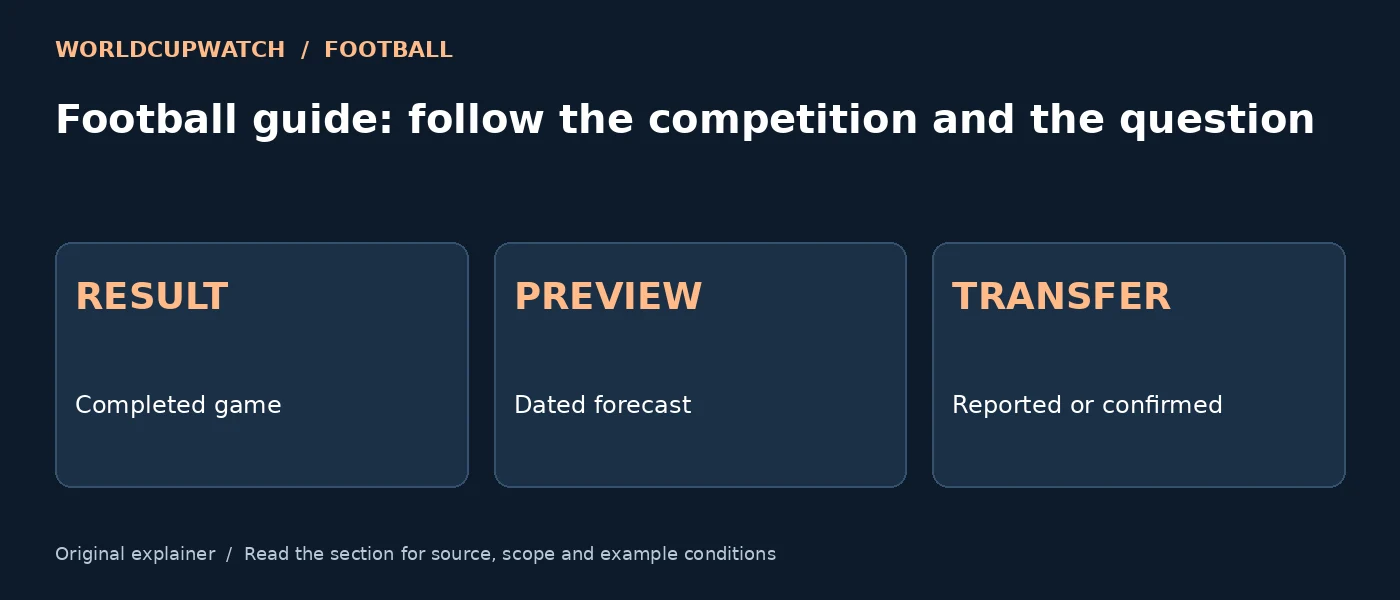
Start with the competition. A national team and a club can share players while participating in different calendars, tables and selection processes. Then identify your question: who won, how a team played, what a reported transfer means, or which match to watch. Choosing that question first helps you find the right resource rather than treating every headline as a complete account of the sport.
Our Results and Reports section collects completed-match coverage. Previews and Predictions supplies the build-up and its original expectations. Transfers follows player moves, while Leagues and Cups gives the competition context. A dated preview can remain useful after a match if you read it as a record of what was known beforehand.
For the completed men’s tournament, the FIFA World Cup 2026 guide is the main reading route. It connects format, qualification, tables, bracket and reports. This general Football hub concentrates on how to understand the different kinds of coverage, rather than reproducing each tournament table.
If you are new to a team, begin with its competition and recent completed matches. Add player roles and transfer context afterwards. A familiar star’s name can make a story appealing, but the team’s objective and the actual match situation explain why that appearance or move matters.
Club football and international football
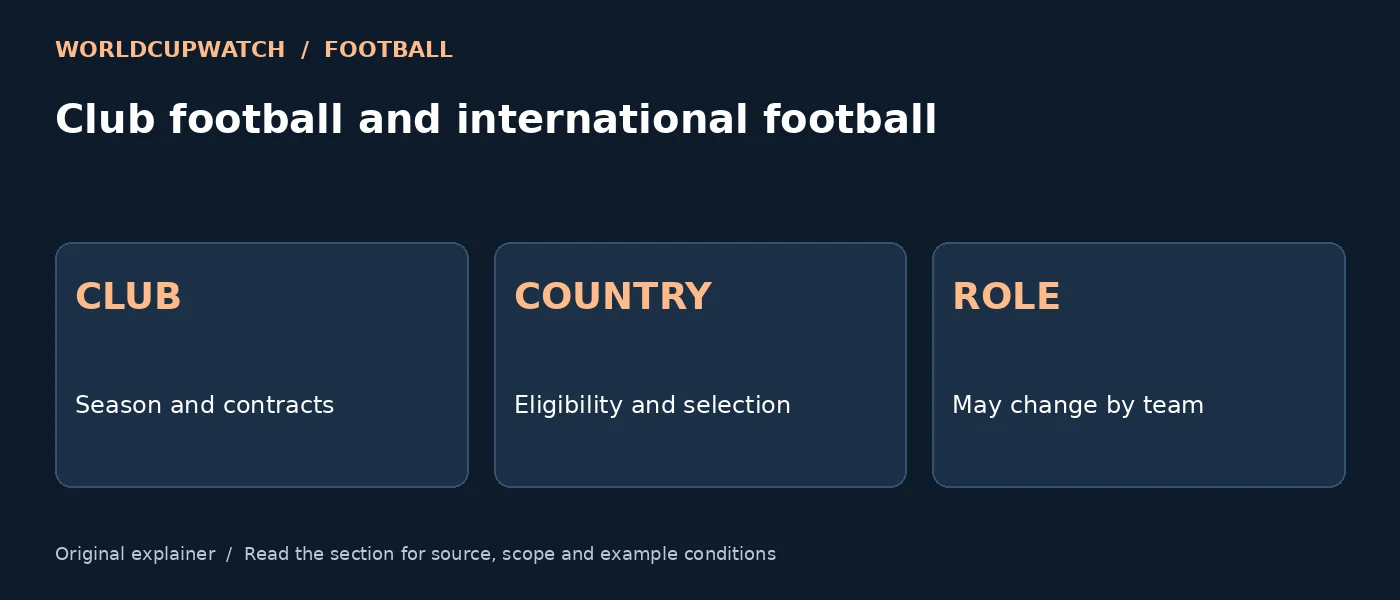
Club football follows organisations that build squads, compete through seasons and make player-contract decisions. International football follows representative national teams, with eligibility and selection determining their squads. A player’s club role can inform an international preview, but it does not automatically define the role their national coach will assign.
Think about the practical difference between watching the same midfielder in two settings. At club level, the surrounding players may have spent months rehearsing a particular pattern. Internationally, the player may operate with a different partner, formation or responsibility. A report should show the observed role instead of assuming that the club’s system travelled with the individual.
Keep the calendar label with every fixture. A national-team window can interrupt a club schedule, and returning players can have different workloads. That creates legitimate questions for a later club preview without establishing that anyone is injured or unavailable. Availability needs its own current confirmation. A travel narrative alone does not prove a selection decision.
For readers following several clubs and countries, a simple tracker can separate the two. Record the competition, opponent, date, result and source. Put a transfer update in a different column from a match result, and mark an expected lineup as a forecast. This gives a player’s story a coherent timeline while avoiding the common mistake of treating a rumour, a national call-up and a club team sheet as the same kind of announcement.
League tables and cup brackets answer different questions
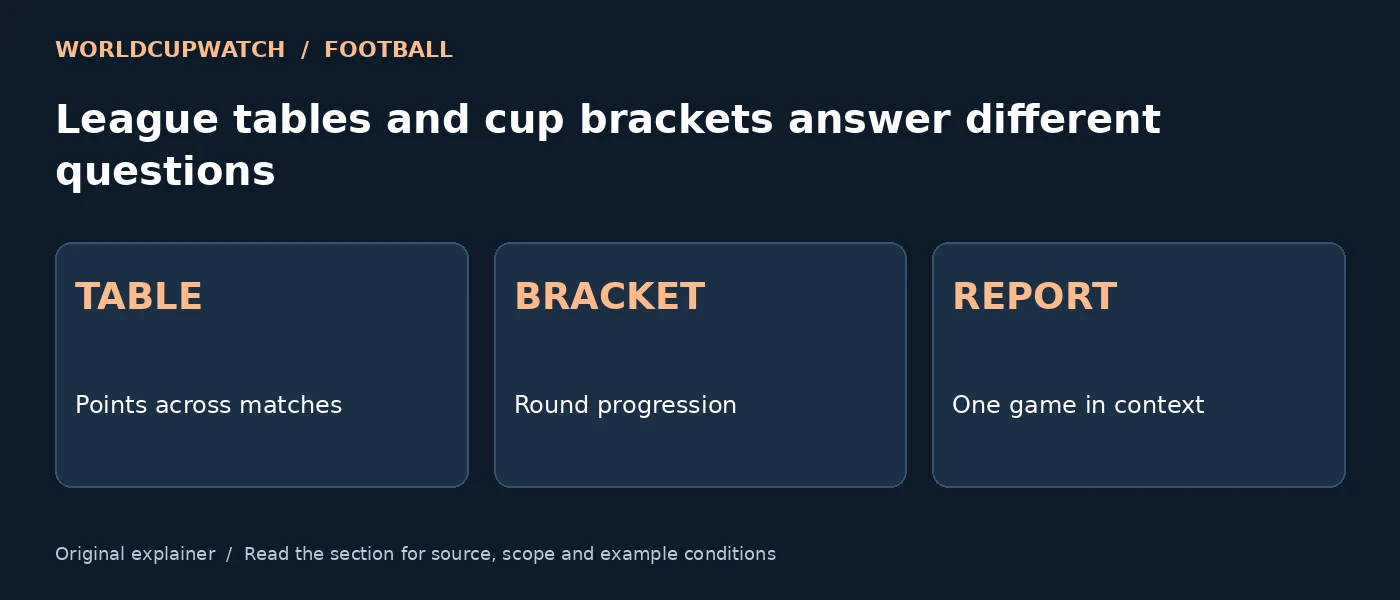
A league table summarises a series of matches under the competition’s points and tie-break rules. A cup bracket shows progression through particular rounds. Some events contain both forms, so the stage label matters. A team that leads an early group still has a different task when it reaches a knockout match.
When reading a league table, compare played matches and results alongside points. A side with a game in hand has another opportunity, not a guaranteed additional victory. The opponent and remaining schedule affect the practical challenge. Avoid adding an assumed win to the table just to make your preferred team appear first.
A bracket has a different reading method. Find the round, identify the two participants and follow the advancing team to the next slot. In a completed archive, the route should be supported by results. In an unfinished competition, a possible opponent remains conditional until the preceding games determine it. A bracket graphic is useful only when that distinction is visible.
For 2026, use our group standings and knockout bracket together. The first explains the final group order; the second explains the route through the elimination rounds. A match report then supplies the narrative for one game along that route. Each resource serves a different purpose, which is why all three can belong to the same topic cluster without being duplicate pages.
Reading a result: full time, extra time and penalties
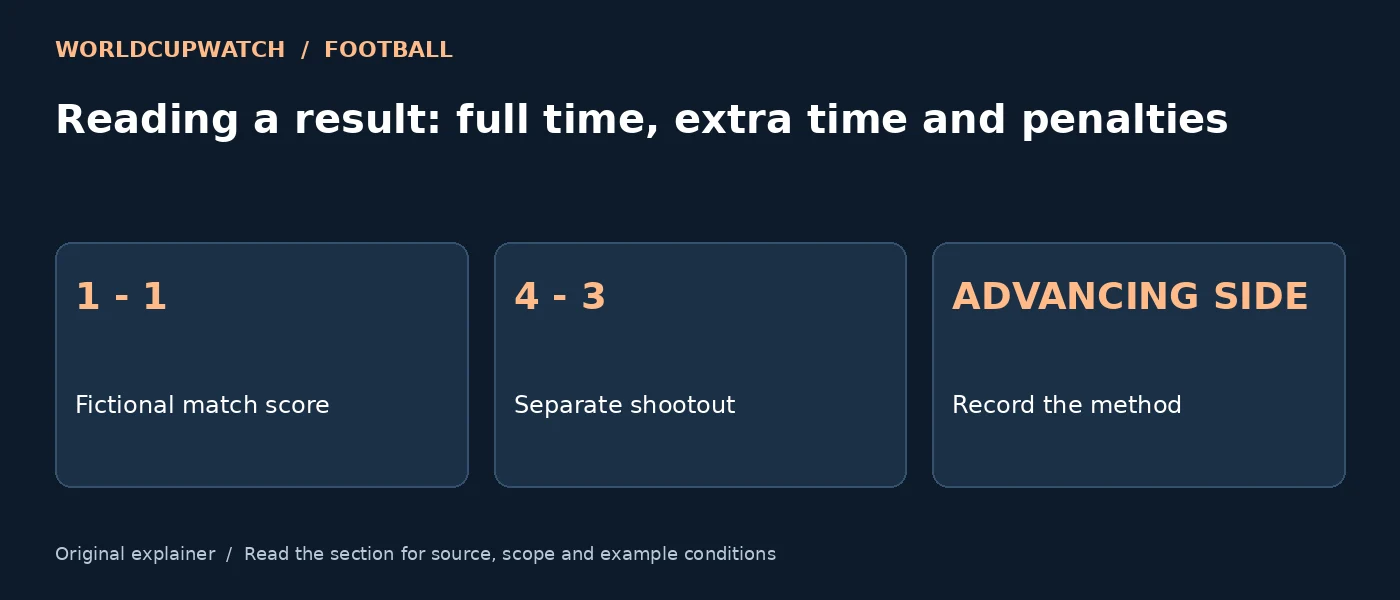
A football result needs its competition, date and stage as well as the score. For a knockout game, also check whether the listed outcome follows extra time or a separate penalty shootout. A short social caption can compress those details, making a drawn match followed by a shootout win resemble an ordinary victory in open play.
Here is an original, fictional example. Team Green and Team Gold finish the playing time at 1–1, and Green wins a shootout 4–3. Record the match score and the shootout score separately. Writing only Green 4–3 Gold loses the information that the teams were level during the match. A score of 2–1 after extra time describes a different route to a winner.
The same discipline helps with player statistics. A decisive shootout kick should be described in its own context rather than silently added to a player’s match scoring total. When comparing records, use the competition’s published definitions. The report should explain the moment, while the statistics resource should retain a consistent scope.
For our World Cup coverage, start from the completed results archive and then select the specific report. If a title and a table appear different, compare the date, round and result fields before assuming they describe the same game. Similar opponents can meet in more than one competition, and archived previews can remain alongside later reports.
Group qualification and tie-breakers
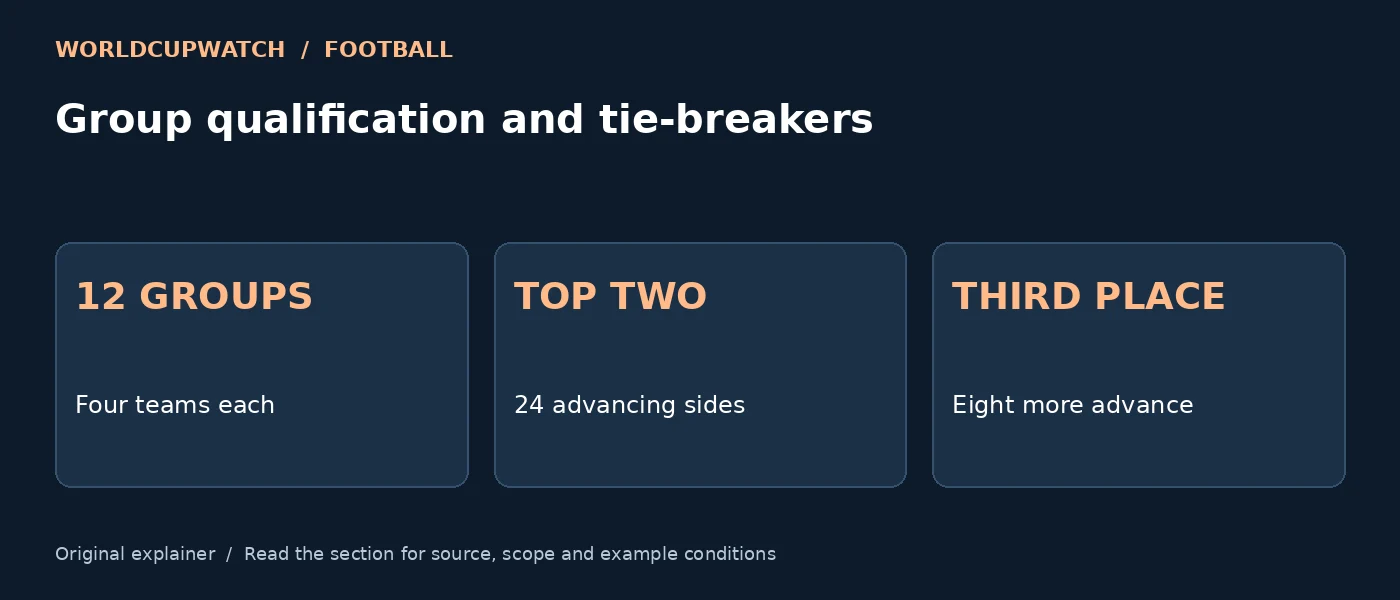
Group qualification depends on the event’s actual progression rules. Finishing second, third or fourth does not mean the same thing in every competition. Points identify part of the table, while tie-break criteria resolve specified equalities. The order of those criteria must come from the relevant edition’s regulations, not from memory of an older tournament.
The 2026 men’s World Cup used 12 groups of four, with the top two in each group and eight of the twelve third-placed teams advancing. That created two separate comparisons: ranking sides within a group and comparing third-placed sides across groups. Our tournament-format guide explains the distinction and supplies original reading examples.
As a general exercise, imagine a side has completed its fixtures in third place. Its own group position is settled, but its progression can depend on other groups. Look for the cross-group comparison and its completion status before announcing that the team has qualified. A points total discussed as historically sufficient is not the same as a mathematical guarantee under the current event’s results.
When reporting qualification, specify the destination round. Qualified for a continental event, qualified for a World Cup and advanced to the World Cup knockouts are different achievements. That makes a headline more useful to someone arriving from search, and it gives the next report a clear sporting question to answer.
Formations and the roles behind the numbers
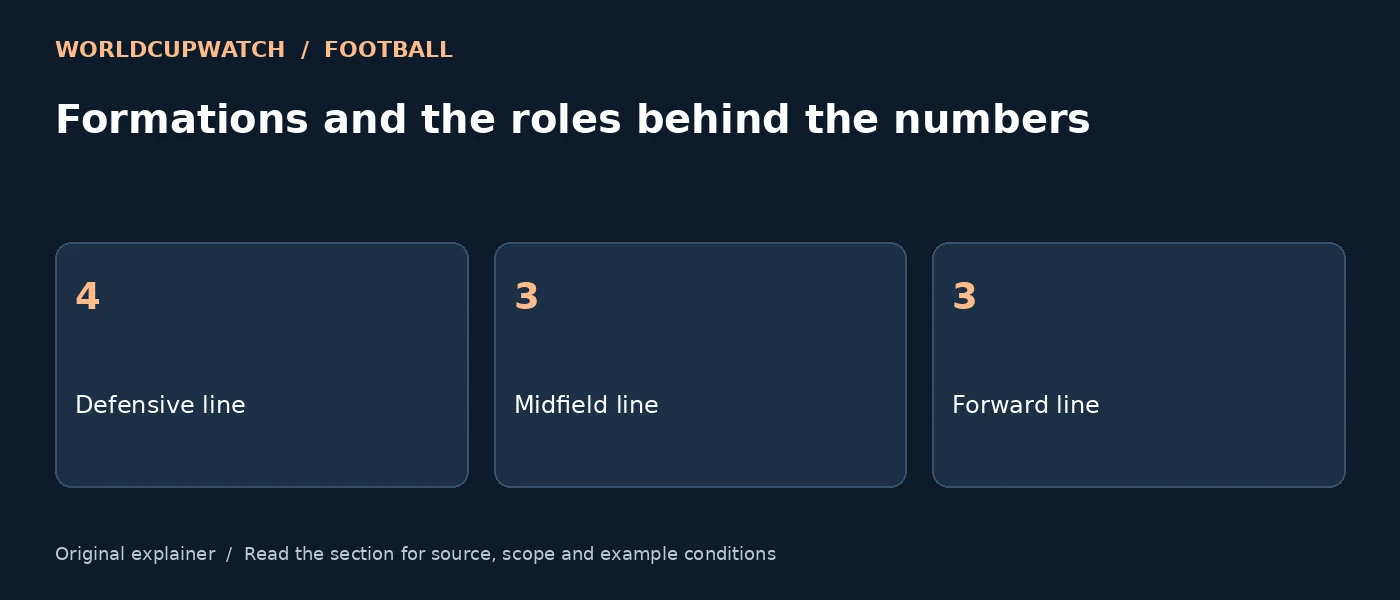
A formation is a useful starting description of how a team is arranged, but it cannot capture every movement. The same nominal structure can defend one way and attack another. A full-back can move into midfield, a winger can move inside and a forward can drop towards the ball. Those changes need observation or supporting match analysis rather than inference from the formation label alone.
Consider a hypothetical 4–3–3. The numbers describe the usual outfield arrangement, not the position of every player at every moment. If a midfielder moves forward and a wide defender comes inside, the attacking shape can look different. A good explanation identifies the phase and the movement rather than announcing that the graphic proves the system changed permanently.
Player roles also depend on nearby support. A forward asked to hold the ball and connect teammates is doing a different job from one repeatedly running behind the defence. Goals are relevant to both, but they do not describe all the work. An evaluation should connect the recorded output with the responsibility visible in the match.
For readers, a productive viewing exercise is to follow one player for a short passage away from the ball. Notice where they move when possession changes and which teammate occupies the space they leave. This makes tactics easier to recognise without requiring a technical vocabulary. A named starting XI and a schematic graphic can orient you; the actual play supplies the explanation.
Pressing, transitions and controlling space
Pressing involves applying pressure when the opposition has the ball. A transition is the passage after possession changes. Both are useful concepts for understanding why an apparently routine turnover becomes a chance. The important detail is the relationship between the player applying pressure, the nearby support and the space left elsewhere.
In a hypothetical sequence, a forward closes the ball-carrier while a teammate blocks the easiest passing route. The ball-carrier attempts a more difficult pass and loses possession. That sequence can support an explanation of coordinated pressure. Merely seeing a player run quickly does not establish that the whole team successfully pressed; the support and outcome matter.
After a turnover, some teams look to attack an unsettled defence, while others first secure the ball. The decision depends on the available options and game state. A late lead and an early deficit can change the practical value of taking a risk. A match report should identify that situation instead of treating every fast move as the team’s permanent style.
When assessing a transfer or lineup, ask how the player’s skills fit these phases. Can they receive under pressure, cover the space behind a teammate, or supply the next pass after a regain? These questions give squad analysis a concrete purpose. They are more informative than saying that a move transforms a team simply because the fee or the player’s reputation is striking.
Possession, shots and the context statistics need
Possession share describes an aspect of the match, but it does not by itself establish who created the better chances. A side can circulate the ball without entering dangerous areas, while another can create opportunities during shorter possessions. The score, shot locations and sequence of play help explain how the possession was used.
Imagine two fictional sides produce ten shots each. One takes several from difficult distances; the other reaches closer positions but fails to score. An equal shot count hides that difference. To judge chance quality, use the actual opportunities or a clearly identified data model rather than assuming every attempt carried the same threat.
Expected goals is a model-based estimate of chance quality, not an alternative final score. Different providers can use different inputs and definitions. Retain the provider, competition and sample when making a numerical comparison. A report should not publish an invented xG figure because a match looked one-sided.
For player comparisons, opportunities and minutes matter as well as totals. A substitute’s small sample can produce a striking per-minute rate that does not establish the same sustained contribution as a full campaign. Set pieces, penalties and the team’s overall style can also affect output. Our Stats and Records coverage should define those scopes so a number helps the reader assess the claim.
Match previews that explain the contest
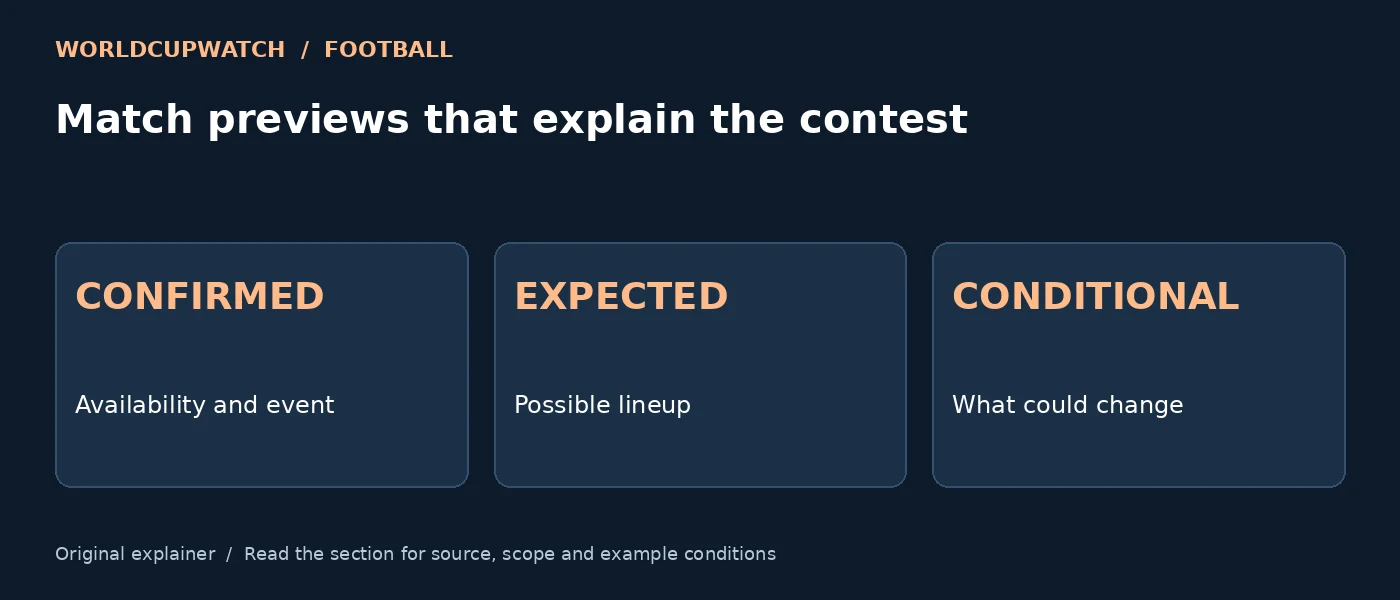
A useful preview identifies the competition, the current situation, confirmed availability and the main questions the matchup may test. It should tell the reader why this game matters before moving into a possible lineup. A predicted XI remains a prediction until the official team sheet establishes the selection.
Begin with the task for each side. One may need a win, while another may be managing progression under the competition’s rules. Then examine relevant form and the opponent. A run of results against very different opposition can be useful background without being a direct forecast of this game. Explain the difference rather than relying on the headline number of consecutive wins.
The clearest tactical preview uses a conditional question. For example, if a fictional side presses high, can its opponent find the space behind the first line of pressure? That gives a supporter something concrete to watch. It does not require pretending that the coach has disclosed a private instruction or that the match will follow one script.
After publication, a meaningful new squad or fixture announcement should update the preview’s facts. Once the match is complete, link to the report and retain the earlier expectations as historical context. Our Previews and Predictions category and results coverage form that before-and-after reading route.
Favourites and predictions: separate likelihood from certainty
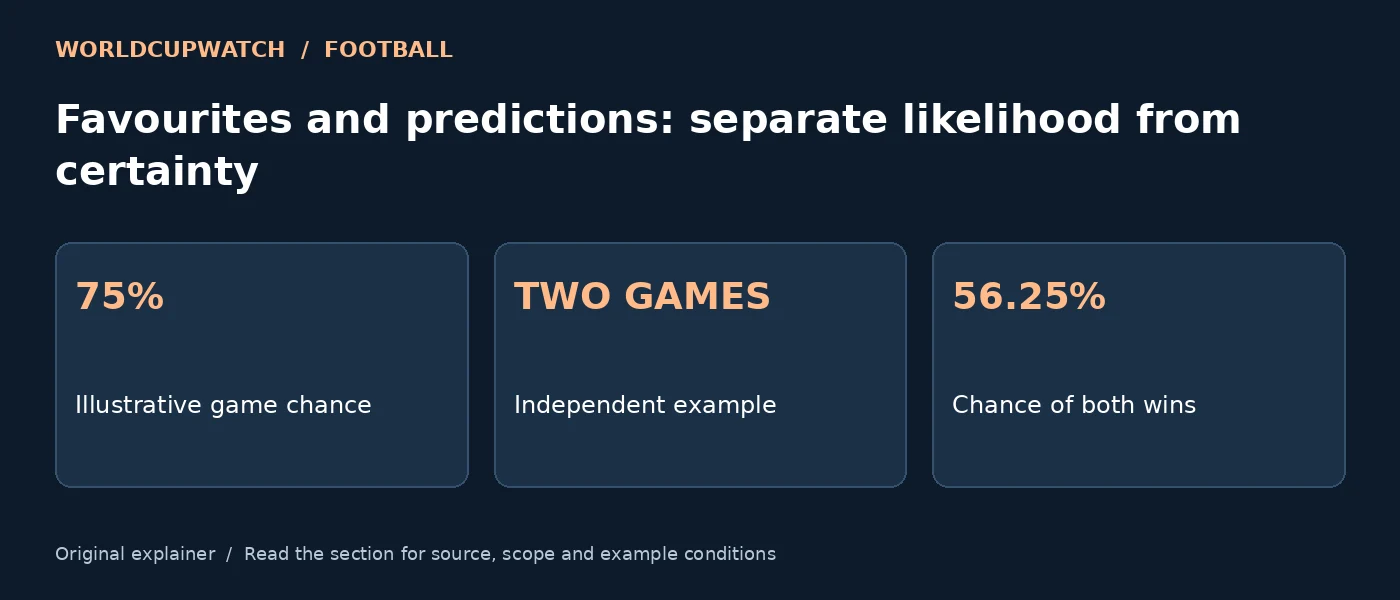
A favourite is the team assessed as having the strongest prospects before a specified event. That assessment can change with squad availability, opposition and format. It does not guarantee a trophy or a single-match result. A tournament forecast also has to account for several stages, rather than treating the strongest starting reputation as the final outcome.
Here is a fictional arithmetic illustration, not a betting estimate. If a model gave a team a 75 per cent chance in each of two independent games, the chance of winning both would be 0.75 multiplied by 0.75, or 56.25 per cent. Real fixtures need not satisfy those assumptions. The example simply shows why several favourable individual matchups do not make a whole tournament certain.
For an editorial prediction, state the evidence and the uncertainties in ordinary language. Which roles look strong? Which opponents or conditions could expose a weakness? What current announcement would lead to a reassessment? Readers should be able to evaluate the reasoning even if they disagree with the selected favourite.
The men’s World Cup 2026 is complete. Its predictions now belong to the archive and should be read alongside the outcome, not republished as forecasts for an upcoming event. FIFA’s 19 July championship announcement on X records Spain’s title. Our retrospective contenders analysis discusses how to assess expectations against results.
Transfer news: a report is different from a confirmed move
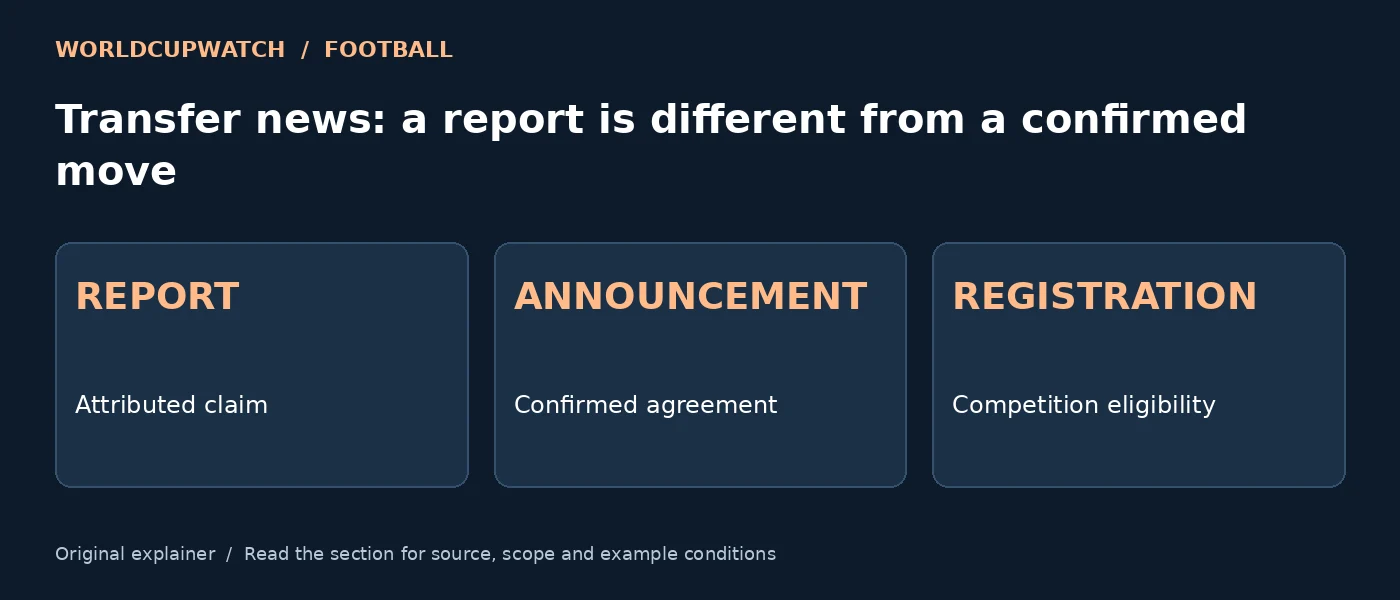
A transfer story can concern interest, negotiations, an agreement or a completed registration. Those stages should remain distinguishable. A player’s name attached to several clubs does not prove that a contract has been signed with any of them. Look for the precise announcement and its date before treating a report as a completed move.
An official club statement can establish the arrival and the published contract terms while leaving the fee undisclosed. A separate report may estimate the price. Both can be relevant, but they answer different questions. A strong article labels the reported figure and its source instead of presenting it as another detail confirmed by the club.
For a reader deciding what the move means, connect it to the role. Which responsibility might the player fill, and which existing player or pattern is affected? The strongest conclusion depends on squad information and observed skills. A high fee alone does not establish tactical fit, while a low initial fee does not eliminate wages or other obligations.
Use our Transfers archive with publication dates in mind. An early report may be followed by a later confirmation, and a story about talks can remain a record of that stage. Follow the newest relevant announcement when assessing the current status. A repeated rumour should not be counted as several independent sources simply because it appears on several sites.
Transfer fees, add-ons and contract length
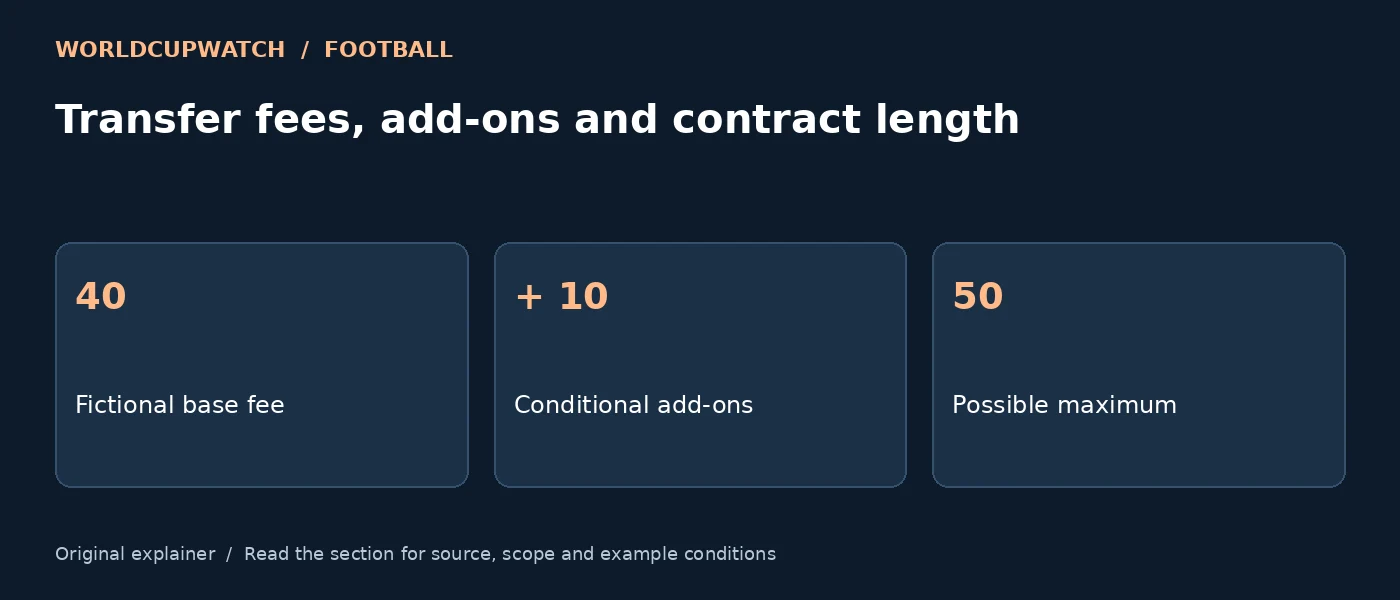
| Fictional fee component | Illustrative value | Meaning |
|---|---|---|
| Base fee | 40 units | Initial specified component |
| Conditional add-ons | Up to 10 units | Only if the stated conditions apply |
| Potential maximum | 50 units | Base plus all possible add-ons |
The money in a transfer headline needs a currency and a definition. An initial fee, a maximum including conditional add-ons and a wage estimate describe different commitments. Two headlines can discuss the same deal using different totals. Check the components before calling one a new record or comparing it with another move.
Suppose a fictional report describes a fee of 40 million plus up to 10 million in add-ons. The maximum potential total is 50 million, but that does not establish that all conditions have been met or all payments made. Keep the initial amount and maximum separate. Changing currencies also needs a specified exchange rate and date; silently converting can create another apparent discrepancy.
Contract length helps describe the player’s commitment and the club’s planning horizon. It is not itself a guarantee of appearances or a forecast of resale value. Options, extensions and other terms matter when disclosed. Avoid filling gaps in a public statement with assumptions about private negotiations.
For analysis, consider both the sporting role and the financial definition. A move can address a squad need without being the cheapest, and an attractive fee can still lead to an uncertain fit. Our existing Morgan Rogers transfer explainer and Rodri transfer explainer separate announced contract information from reported prices. Read them in their stated publication context.
Squad depth, rotation and a player's contribution
Squad depth concerns the available alternatives for particular jobs. Counting familiar names does not tell you whether the side can cover a missing position or preserve a tactic during a busy period. A reserve who supplies the required skill can be more relevant to a specific matchup than a more celebrated player whose role is different.
Consider a fictional team that can replace several attacking players but has only one established option for a particular defensive task. Its depth is uneven. A schedule containing several difficult games can make that imbalance important, but it does not establish that a player will be injured or rested. The preview should identify the planning question and wait for confirmed availability.
Rotation can change relationships as well as individuals. A new combination may need to coordinate movement, passing and cover. A single weak result does not prove that rotation always fails, and one strong substitute appearance does not establish that the player should start every fixture. Compare relevant performances and the actual responsibility given.
When analysing a player, include work without the ball and contribution to a sequence where the evidence permits it. Goals and assists are valuable records, but they do not capture every useful action. The best explanation connects the player’s contribution to the team’s objective rather than compiling a list of compliments that would suit anyone in the squad.
Football news, quotes and original posts on X
FIFA’s original launch post on 11 June 2026 described the tournament’s scale. Read this as a dated launch statement:
“a great success”
Arsène Wenger, FIFA Chief of Global Football Development — FIFA tournament blog, 18 July 2026 — official published source · Original X reference
A news report should establish the development, its date and its significance. A player comment, a coach’s preference and an official competition decision need different framing. Readers should not have to infer whether a confident sentence is a confirmed announcement or our interpretation of an attributed opinion.
For X references, use the original status and confirm the account identity. The original date matters especially when an old post circulates during a new discussion. A screenshot can remove context, while a repost’s caption can attach a different meaning. A verified account indicator alone does not settle whether a quote concerns the match described in the article.
The World Cup archive includes dated original FIFA posts where they support the relevant point. FIFA’s 11 June post identifying 48 nations and 104 games is tournament-opening background, not fresh October news. The title announcement belongs to 19 July. Keeping those dates visible lets the page connect official records with editorial explanation without confusing the timeline.
Our Football Desk and Editorial Policy explain responsibility and corrections. A useful update adds verified information or a substantive analysis change. Moving a publication date or recycling an old quote without a new development does not give the reader a more current account of the sport.
Watching from Pakistan, India and the UAE
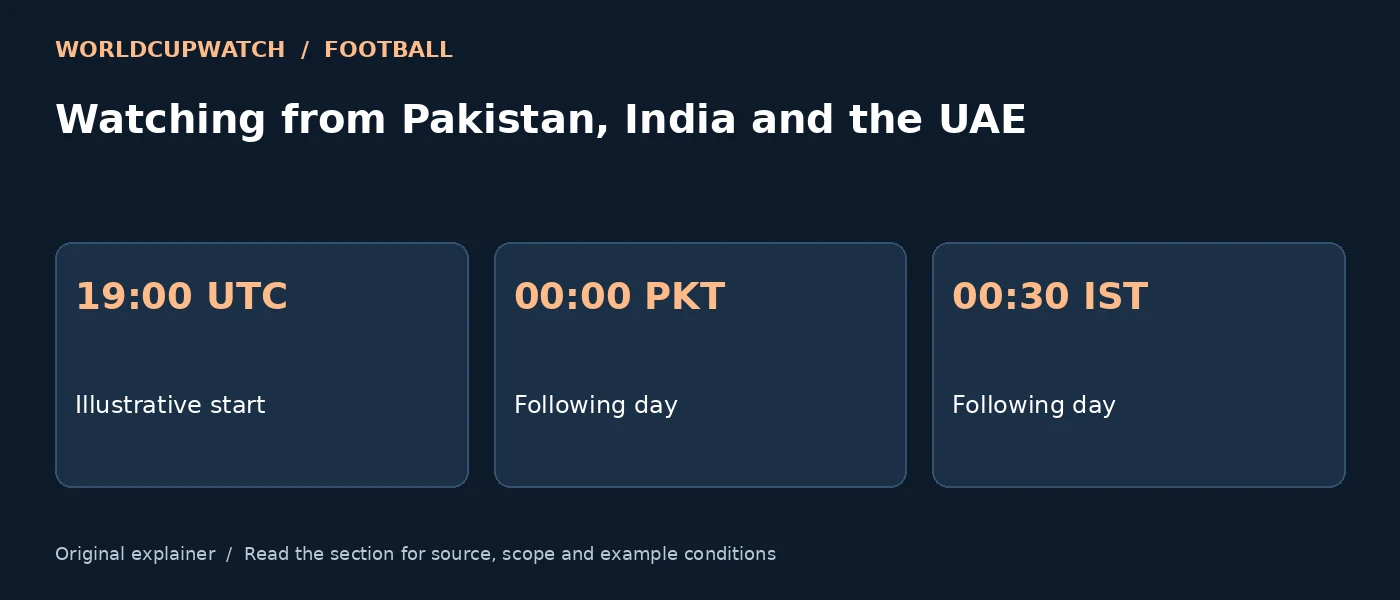
Start with the confirmed fixture time and its original timezone. Pakistan is UTC+5, India UTC+5:30 and the UAE UTC+4. A host city or a broadcaster may display a different local time, and some countries change their clocks seasonally. Convert the exact listed time for the match date rather than relying on a remembered difference.
As an original example, a hypothetical 19:00 UTC kickoff is midnight at the start of the next day in Pakistan, 00:30 that next day in India and 23:00 on the original date in the UAE. The calendar date is part of the conversion. This is a clock exercise, not an announced match. Saving only an hour can put the reminder on the wrong evening.
Viewing access needs its own territory check. Confirm that the service carries the particular competition and whether its current programme offers a live match, a full replay or short highlights. A social video does not establish full-match access, and a subscription covering one competition need not cover another.
For completed World Cup matches, use our replay and highlights guide as a starting point, then check the current listing. Old live-viewing offers can remain indexed after an event finishes. The guide should identify that archive context instead of promising that a past free trial or a previous programme remains available today.
Replays, highlights and learning from a match
Choose the type of recording that matches your purpose. Highlights can show decisive chances, while a full replay helps explain the periods between them. A short clip can make a game look like uninterrupted attack when much of the contest involved careful positioning, pressure and changes in rhythm.
If you want to study a turning point, locate the score and game time first. Watch a passage before and after the incident if a legitimate recording is available. A goal can change the decisions of both teams: one may need to take more risk while the other protects space. The surrounding sequence is often more informative than the finish alone.
For tactical learning, focus on one phase or player instead of trying to explain every movement at once. Follow how a side builds from the back, how it reacts to losing the ball, or how it defends a particular area. Record observations as observations. Avoid converting a plausible interpretation into a claim about a coach’s undisclosed instruction.
Use the match report to establish the result, then compare its explanation with the available record. Different reasonable analyses can emphasise different aspects, but numerical claims should be traceable. An original schematic on our site illustrates a concept; it is not a photograph or an exact tracking map of the match unless the caption explicitly establishes that evidence.
Records, awards and comparisons across competitions
A record needs a defined competition, period and measure. Tournament goals, season goals and career goals describe different scopes. An award for overall play answers a different question from a leading-scorer table. Keep those categories separate before deciding that one statistic proves a player was the best in every sense.
Our World Cup top-scorers page and awards coverage have distinct purposes. The first concerns scoring; the second discusses named honours. Both need the edition label. Neither should be silently updated with club-season numbers that belong to a different competition.
Opportunities affect cumulative totals. A player reaching later rounds can play more matches, while a substitute may have fewer minutes than a regular starter. Rates can help, provided the sample and calculation are clear. A very short appearance can produce an eye-catching rate that is not evidence of sustained performance across an entire tournament.
When comparing eras, explain relevant changes in format and sample instead of treating the totals as interchangeable. The 48-team World Cup included an additional knockout round compared with the earlier 32-team structure. Our event guide explains that route. The useful comparison identifies what the numbers establish and which wider judgments still require football analysis.
Your next Football read and corrections
For the completed international event, open the FIFA World Cup 2026 guide. For current club and international developments, choose Football News. For roster changes, use Transfers. The category links above connect these subjects without treating every article as another version of the same broad guide.
If a report interests you, follow its context link to the competition table or bracket. If a transfer story interests you, establish its publication date and the current status before using it to assess a squad. If a prediction interests you, look for its stated evidence and a later review. Those small habits make it easier to recognise what the article actually contributes.
Corrections can be sent through Contact Us with the specific statement, source and date. A clear reference allows the Football Desk to check whether the issue concerns a score, a stage, a reported term or an interpretation. Our source and commercial disclosures should remain visible where they are relevant.
Football offers plenty of room for disagreement about tactics and players. The strongest discussion starts with a shared understanding of the result and the evidence. This hub gives you the routes to those records and the vocabulary to evaluate the analysis, whether you follow a club season, a transfer window or a national team at a World Cup.
Related football articles
FIFA World Cup 2026 guide — The completed tournament’s format, group comparisons, knockout route, source timeline and result resources.
World Cup 2026 final report — The title-game reading route; consult the report for the match narrative and result details.
FIFA opens an investigation — A dated post-final announcement. An investigation’s opening is a separate fact from a later decision or sanction.
World Cup 2026 bracket — Follow the elimination rounds together instead of reading isolated results without their place in the tournament.
Replays and highlights — Read the completed viewing guide, then check current licensed availability for your country.
Have a question about this guide or a specific correction? Use the comment form below. Include the section and the source date so the Football Desk can check the detail.
More related coverage, added 13 October 2026.
- Offside rule explained — Six invented situations illustrate position, involvement and the relevant touch.
- October FIFA ranking changes — The selected movements confirmed in the 7 October edition, with separate analysis.