FIFA World Cup 2026 Guide: Format, Results and Tournament Archive
The FIFA World Cup 2026 guide below covers the completed tournament. This guide explains the tournament’s format and helps you find its results and reference pages. It covers the men’s competition held in Canada, Mexico and the United States, rather than upcoming fixtures.
Reviewed 6 October 2026. Use the links below to explore the completed event. For current club and international stories, visit our Football section.
FIFA World Cup 2026 guide: The tournament at a glance
| Item | Detail |
|---|---|
| Tournament dates | 11 June–19 July 2026 |
| Host countries | Canada, Mexico and United States |
| Teams | 48 |
| Matches | 104 |
| Group stage | 12 groups of four |
| First knockout round | Round of 32 |
These edition details follow FIFA’s official tournament schedule and 48-team format explanation. A schedule entry should be checked by its date and round when comparing it with a match report.
How the 48-team format worked
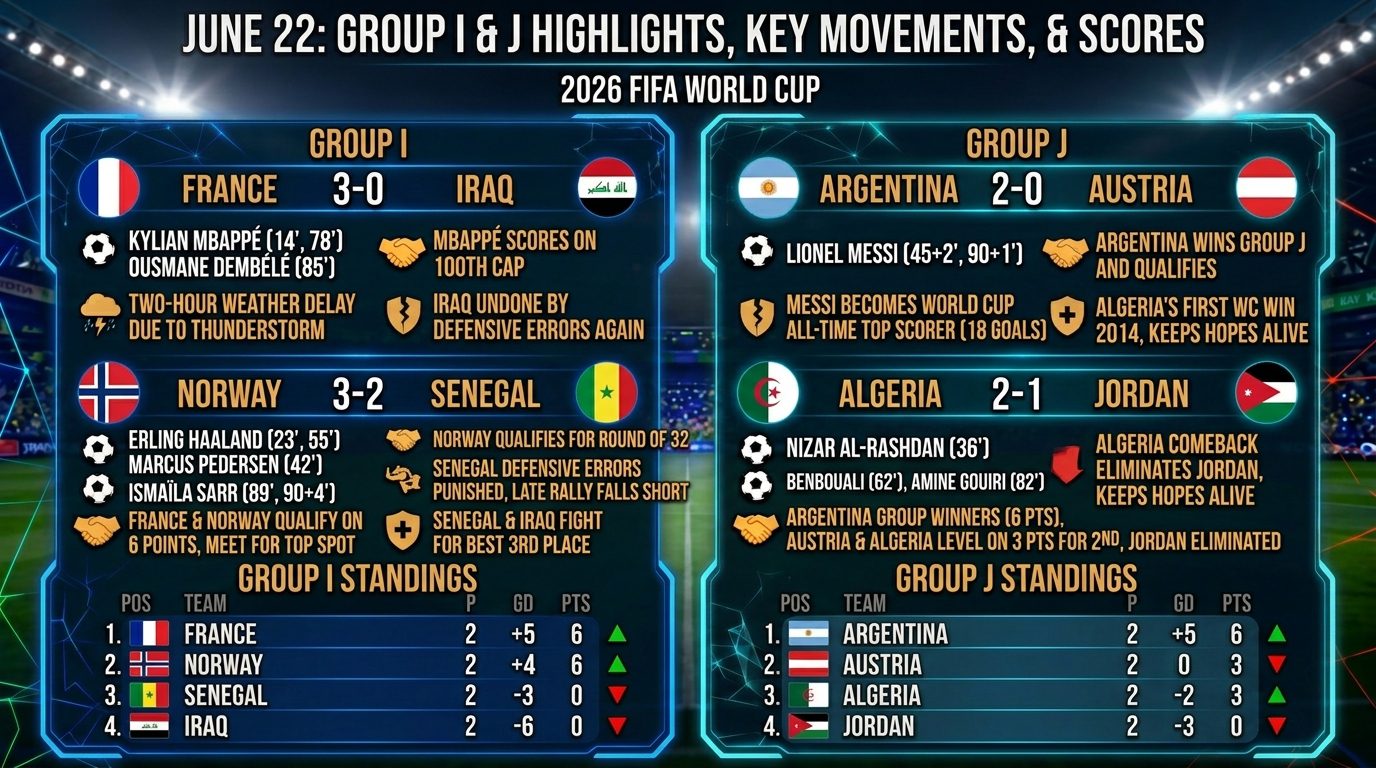
The top two teams in each group and the eight best third-placed teams progressed to the round of 32. Finishing third therefore did not automatically mean elimination, but it did not guarantee qualification either.
Once the group stage ended, the knockout bracket tracked a team’s route through successive rounds. Reading the group standings alongside the bracket makes it easier to understand why a nation qualified and who it faced next.
Where to find the results
Start with the group standings to see the group-stage picture. Then use the knockout bracket to follow the route to the final. These pages answer different questions: a table records a group’s finishing order, while a bracket records knockout progression.
The results archive collects reports. For a specific stage, choose the round of 32, round of 16, quarter-finals or semi-finals.
Our final report covers the deciding match. Use team profiles for background and the top-scorers page for scoring coverage.
How to read a historical preview
A preview describes what was known before kickoff; a result report describes what happened afterwards. A predicted winner or possible lineup in an old preview is not a final result. Check the publication date and use the relevant report when following a completed match.
An article about 2026 also should not be treated as a guide to a later tournament’s format or viewing rights. The edition and competition name matter when moving between international events.
Watching highlights or replays
The live tournament has ended. Our World Cup 2026 replay and highlights guide links verified official options and explains availability checks. Access can depend on your country and the individual programme’s current listing.
Coverage and corrections
WorldCupWatch is an independent publication. The Football Desk explains its coverage, and our Editorial Policy sets sourcing and corrections standards. If a reference entry needs correcting, send the page and disputed detail through Contact Us.
Official references: FIFA schedule and results · FIFA format explanation.
Why 48 teams produced 104 matches
Each of the 12 groups contained four teams. A round-robin group therefore required six matches, producing 72 group games in total. The round of 32 added 16 matches, followed by eight in the round of 16, four quarter-finals, two semi-finals, the third-place match and the final. Those 32 knockout and placement matches brought the edition total to 104.
The arithmetic also explains why the bracket begins earlier than in a 32-team World Cup. Reaching the final required a team to progress through five knockout rounds after its three group games. A match report from the round of 32 should therefore not be labelled a round-of-16 result.
Which reference page answers your question?
For qualification, read the group standings. For an opponent and route through the knockouts, use the bracket. For one match, read its dated report. For individual scoring, use the top-scorers table. Keeping those purposes separate lets each page answer a specific question without repeating a whole tournament guide.
A score shown as 1–0 after extra time is different from a match won in a penalty shootout after a draw. When checking a result, note the score, whether extra time was played, and whether a separate shootout score is listed. Compare the same fields in the official record.
The structure is documented in FIFA’s edition and format guide. This page is a reference for 2026; future editions should be checked against their own regulations.