
Cricket World Cup 2027: Qualification, Format & Favourites
Reviewed 8 October 2026. A practical guide to qualification, the tournament route, Pakistan and India fixtures, early favourites and the news behind the competition.
Read this guide: Cricket World Cup 2027: dates and the essential facts · How Cricket World Cup 2027 qualification works · Groups, teams and what the table tells you · The format: Super Series, groups, Super 7 and knockouts · Pakistan’s World Cup route and a guide for PKT readers · India’s campaign and a guide for IST readers · Host countries, venue labels and conditions · Who is favourite for Cricket World Cup 2027? · How our predictions will be built and reviewed · Points tables, tie-breaks and net run rate · Tickets, start times and watching from your country · Latest qualification news and dated player references · Questions about qualification, favourites and the schedule · Official sources, related guides and corrections
Cricket World Cup 2027: dates and the essential facts
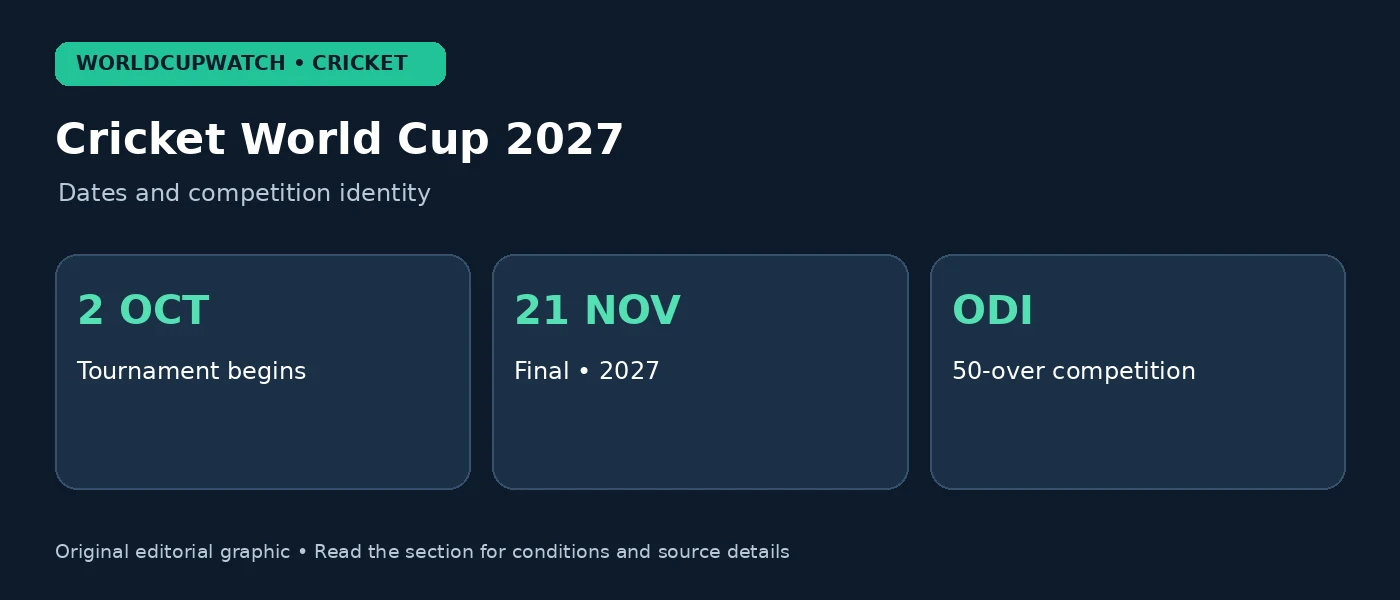
The ICC Men’s Cricket World Cup 2027 is scheduled for 2 October–21 November 2027 in South Africa, Zimbabwe and Namibia. It is the men’s ODI competition. The event has 14 participating teams, but only 12 reach the main group stage after the opening Super Series. That distinction explains why different previews can describe different team counts without necessarily discussing different tournaments.
| Stage | Dates in 2027 |
|---|---|
| Super Series | 2, 4 and 6 October |
| Groups | 7–24 October |
| Super 7 | 25 October–14 November |
| Semi-finals | 17 and 18 November |
| Final | 21 November |
This hub is for supporters who want to understand what a fixture means, how their team advances and what to check before planning a day of cricket. You can start with qualification if your question is who has a place, or go straight to the Pakistan and India sections if you are following those teams. Predictions are identified as our assessment; announced tournament details are supported by ICC references.
A date, a start time and a confirmed opponent are three separate pieces of information. A schedule may establish the first without establishing the second, and later rounds can use placeholder positions rather than guaranteed teams. Before saving a match, record the event, stage, venue, local date and time-zone label together. This avoids confusing an ODI World Cup fixture with a T20 international or a domestic league game.
The page was reviewed on 8 October 2026. Its current-news section uses the date of the actual announcement or match, rather than presenting an older statement as a new development. Future squads, injuries, broadcast access and any changed fixture must be checked closer to the event. The current schedule reference is the ICC fixture announcement.
For a quick reading route: establish the team’s entry route, find its group, understand the progression rule, then consider the opponent and conditions. An exciting individual match can matter differently depending on those steps. A close defeat early in a group is not automatically elimination, while winning a qualifying competition does not always mean the team has reached the World Cup group stage.
How Cricket World Cup 2027 qualification works
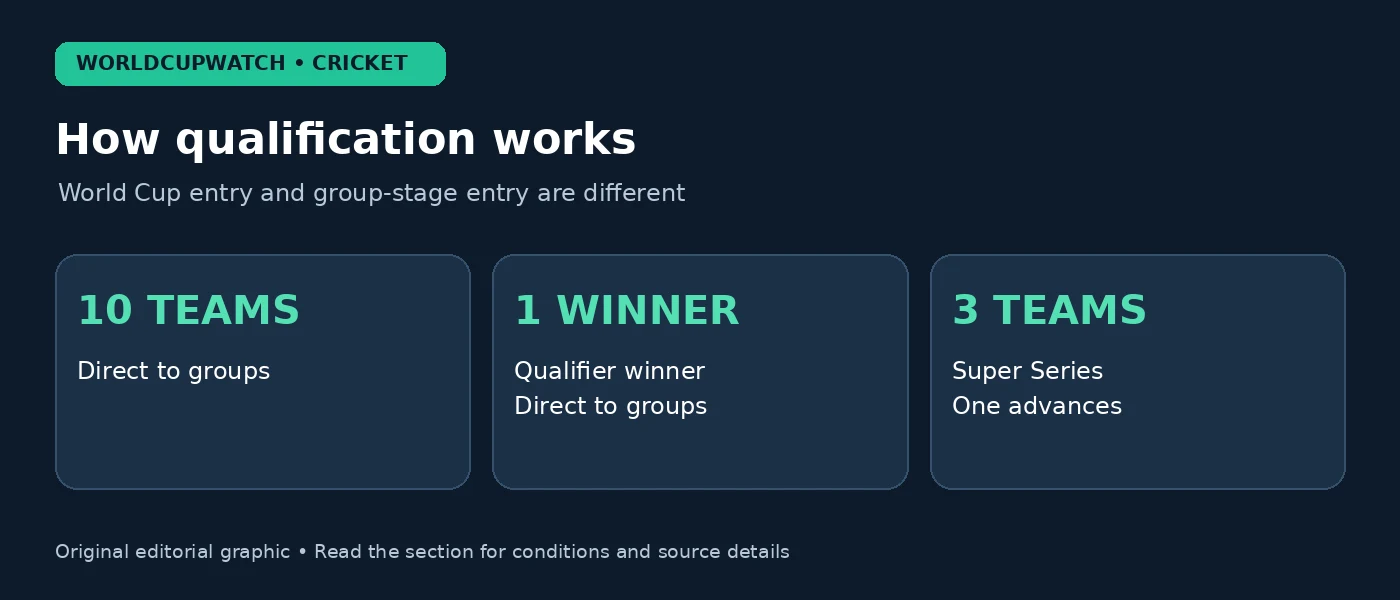
There are two questions: has a team qualified for the World Cup, and has it qualified directly for the group stage? The ICC describes ten direct group-stage entrants: full-member hosts South Africa and Zimbabwe, plus eight teams determined by the ODI ranking cut-off of 30 September 2026. Four more World Cup participants come through the 2027 Qualifier.
The Qualifier winner enters the group stage directly. The teams finishing second, third and fourth enter the opening Super Series, where one progresses. Namibia’s role as a co-host does not itself provide the automatic full-member host place. These entry routes are set out in the ICC qualification background.
Think of a qualification story as a report about a specific gate. “Reached the Qualifier”, “secured World Cup participation” and “advanced to the groups” describe different achievements. When reading a headline, ask which gate has been passed and which matches still need to be played. A team can have completed one stage of its journey while facing a substantial sporting challenge at the next.
Here is a hypothetical example, not a prediction of the Qualifier. Team Red finishes first and goes directly into the groups. Teams Blue, Green and Gold finish second through fourth and enter the Super Series. If Blue wins that opening competition, Blue reaches the groups while Green and Gold do not. All four qualified for World Cup participation, but only two from this example reach the group round.
This also helps explain why an official placeholder should remain a placeholder. Do not substitute a popular team for Qualifier A or Qualifier B because of reputation or a strong recent result. Until the relevant competition determines the entrant and the official schedule identifies its position, the label describes a route rather than a named opponent.
For a fan following an emerging team, the most useful checklist is entry status, remaining competition, progression requirement and the date of the source. League performances can show improvement, but the later qualifying event is a separate test. Keep its scorecards and standings separate from the World Cup groups so progress is celebrated accurately without turning a possibility into a confirmed berth.
Groups, teams and what the table tells you
The announced group lineup is shown below. The table identifies the ten named direct entrants and the two placeholder positions. It is a group listing, not a live standings table or an order of predicted strength.
| Group A | Group B |
|---|---|
| India | New Zealand |
| Australia | South Africa |
| Pakistan | Sri Lanka |
| Afghanistan | England |
| Zimbabwe | Bangladesh |
| Qualifier A | Qualifier B |
Reading down the rows does not mean India is first in Group A or New Zealand first in Group B on points. A fixture announcement has no played-match standings. Once competition begins, use a table that gives matches played, results and the applicable tie-break information. Without those labels, a list of teams can easily look like a ranking even when it is simply a draw.
A useful way to assess a group is to look at the range of challenges rather than attaching a permanent label such as “easy group”. Different attacks, batting approaches and grounds can ask different questions. A side may be well prepared for pace but less comfortable when an opponent slows the scoring through the middle overs. That is an analysis of a matchup, not evidence that one opponent is automatically weaker.
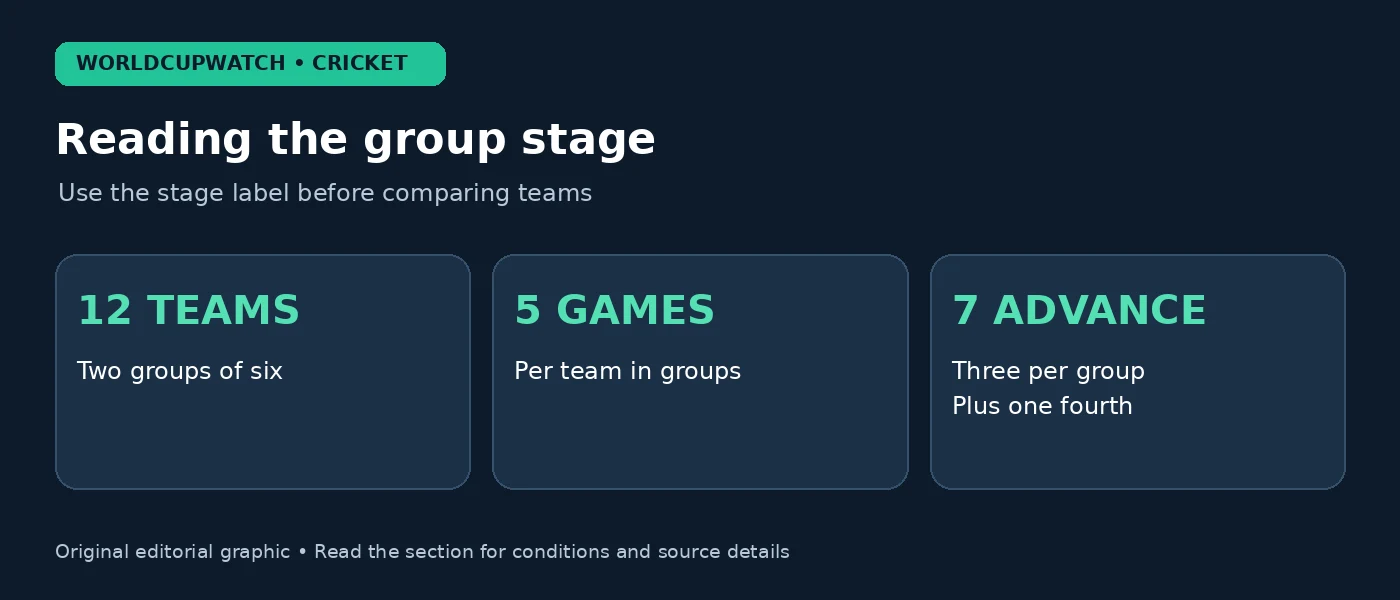
There are five group games per team. A supporter can make a simple tracker with a row for each opponent and columns for the published date, ground, verified result and remaining requirement. Leave the result empty until the match is complete. If you add a forecast, put it in a separate prediction column rather than letting it resemble an actual score.
Suppose a hypothetical team starts with two victories and then loses. Its supporters should look at the remaining fixtures and the current table before announcing that qualification is secured or lost. A standings position after three matches is a snapshot. Different numbers of completed games and rain interruptions can make comparisons harder, which is why matches played belongs beside points.
The group identity remains useful even after a team advances: it tells the story of the route taken. The later-round calculations, however, need their own stage label. Preserve the group table as an archive instead of overwriting it with a different competition round. Readers should be able to tell whether they are examining the draw, an in-progress table or a completed stage.
The format: Super Series, groups, Super 7 and knockouts
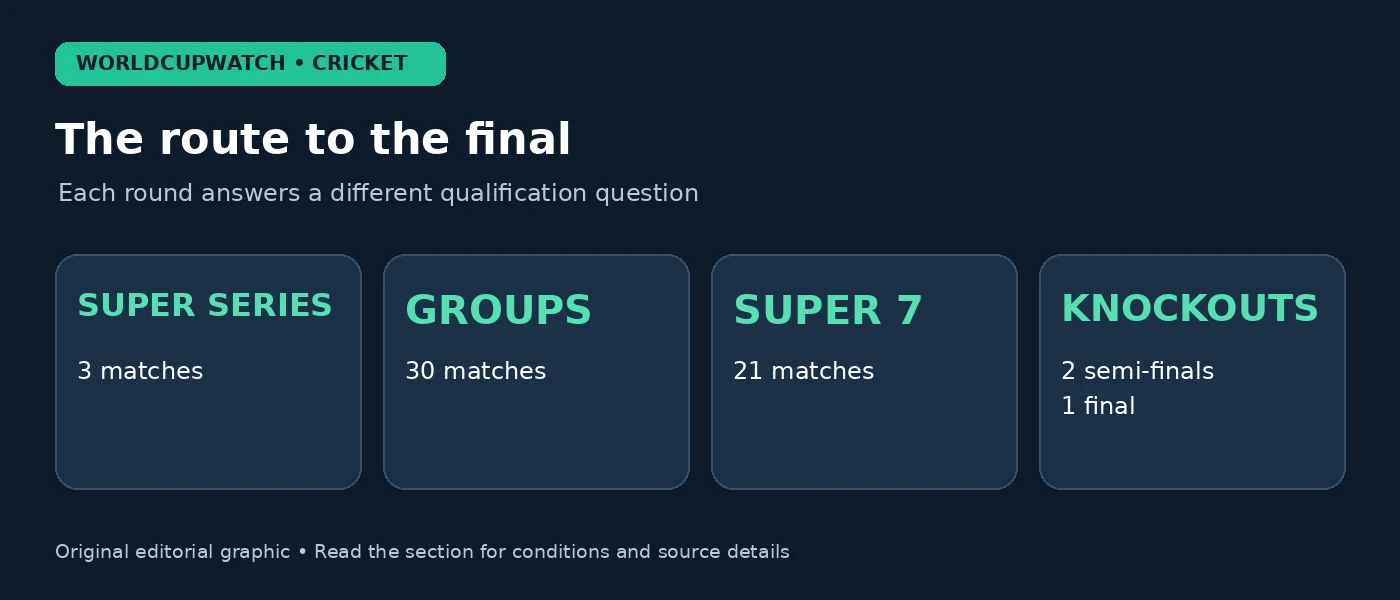
The announced route has three rounds before the semi-finals. The Super Series is a three-match round robin. The group round has two groups of six and 30 matches. The top three in each group and the better fourth-placed side advance. Seven teams then play a 21-match Super 7; its top four reach the knockouts. First faces fourth, and second faces third. The winners meet in the final.
Those match totals come from the ICC format announcement. They also give a useful arithmetic check: three opening matches, 30 group games, 21 later-round games and three knockout matches add up to 57. Counting the rounds helps identify an outdated article that uses a different tournament structure.
For understanding a round robin, imagine a small group with three teams. Red plays Blue, Red plays Green, and Blue plays Green: three fixtures, not six, because each pairing is counted once. With six teams the same counting principle produces 15 games in one group. Two such groups produce 30. Seven teams playing each other once produce 21.
The format changes the kind of prediction that makes sense. Before a round robin, consistency across varied opponents matters. Before a knockout, the immediate matchup matters much more. A team that has performed well over several weeks can still lose a single elimination game. “Best record so far” and “certain to win the next match” are therefore different claims.
When a team moves into the Super 7, do not assume a named fixture is guaranteed solely because the schedule gives it a seeded slot. ICC says group points do not carry forward, and fixture positions are conditional on advancement. The official format and seeding explanation is the reference for that distinction.
The best practical habit is to read each later fixture in two layers. First read the fixed information: slot, date and place. Then read the condition: which team fills that slot if it qualifies. For example, a pre-seeded name can be helpful for tentative planning while still requiring a successful campaign. A travel decision should take both layers into account.
Pakistan’s World Cup route and a guide for PKT readers
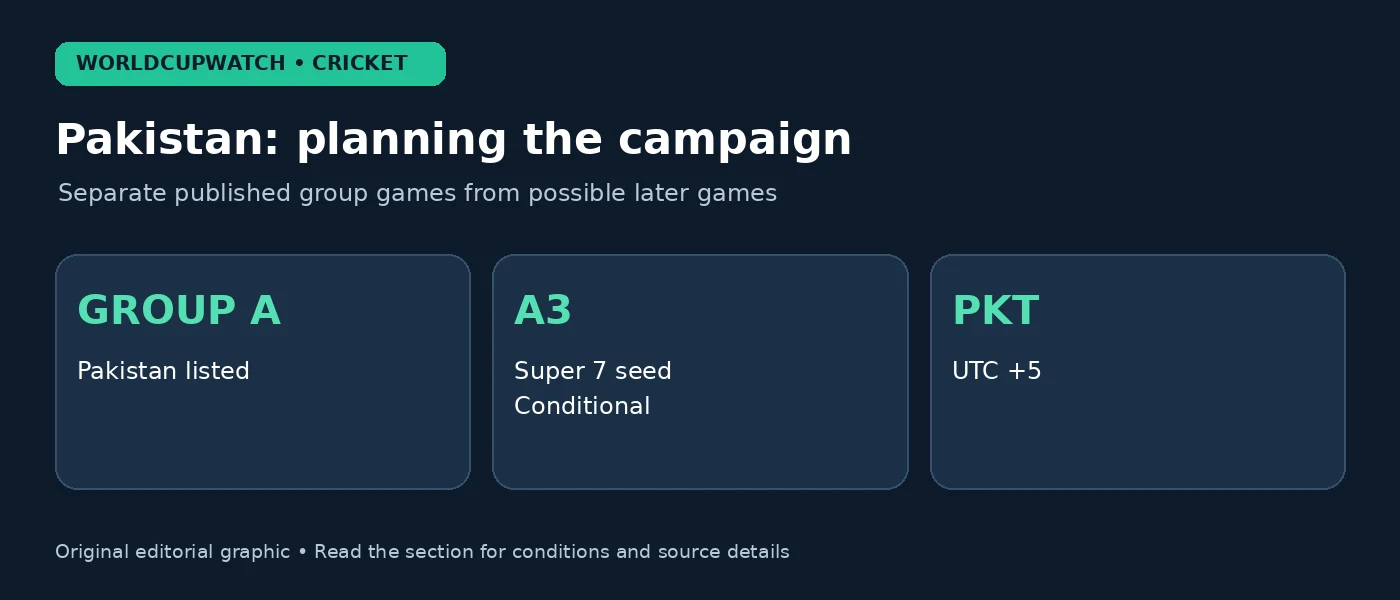
Pakistan is listed in Group A with India, Australia, Afghanistan, Zimbabwe and a qualifier position. The published ICC schedule lists Pakistan’s group fixtures against Afghanistan on 8 October, India on 10 October, Qualifier A on 15 October, Zimbabwe on 19 October and Australia on 22 October 2027. These are announced dates, not match results or confirmed playing XIs.
For Pakistan supporters, the main sporting question is not just the rivalry game. It is whether the team can produce a balanced sequence of performances across the group. A strong showing in a high-profile fixture matters, but the other matches shape the same qualification campaign. Save all the group games rather than treating one opponent as the entire tournament.
A useful pre-match review should ask how the likely batting roles fit together. Who is expected to manage a new-ball spell? Who can keep the innings moving if a boundary is unavailable? Who is trusted to finish an innings after early wickets? These questions can be answered with current ODI evidence once a squad is confirmed; they should not be filled with guessed names a year in advance.
Bowling assessment needs the same care. Look for ways to take wickets in different phases, a reliable option when a main bowler has an expensive spell and fielding that supports the plan. An attack is more than its fastest delivery or most famous player. Match reports that connect a bowling change to the situation are more useful than a list of wickets without context.
Pakistan Standard Time is UTC+5. South Africa and Zimbabwe use UTC+2, so a verified local start there converts to three hours later in PKT. Namibia uses the same UTC+2 offset. As a hypothetical conversion, 10:00 local would be 13:00 PKT. This explains the calculation; it does not announce a first-ball time for any World Cup fixture.
For current internationals rather than next year’s event, use our Pakistan cricket schedule. Keeping those two calendars separate prevents a 2026 home-series match from being confused with the 2027 competition. When a start time becomes official, keep the source date and timezone with it so a revised timetable can be spotted.
Our reading recommendation is simple: follow the full campaign, check ODI rather than only T20 performances, and revisit the assessment when the squad and conditions are known. Support for Pakistan can coexist with a candid evaluation. A useful preview explains both a route to victory and the situation that would make the game difficult.
India’s campaign and a guide for IST readers
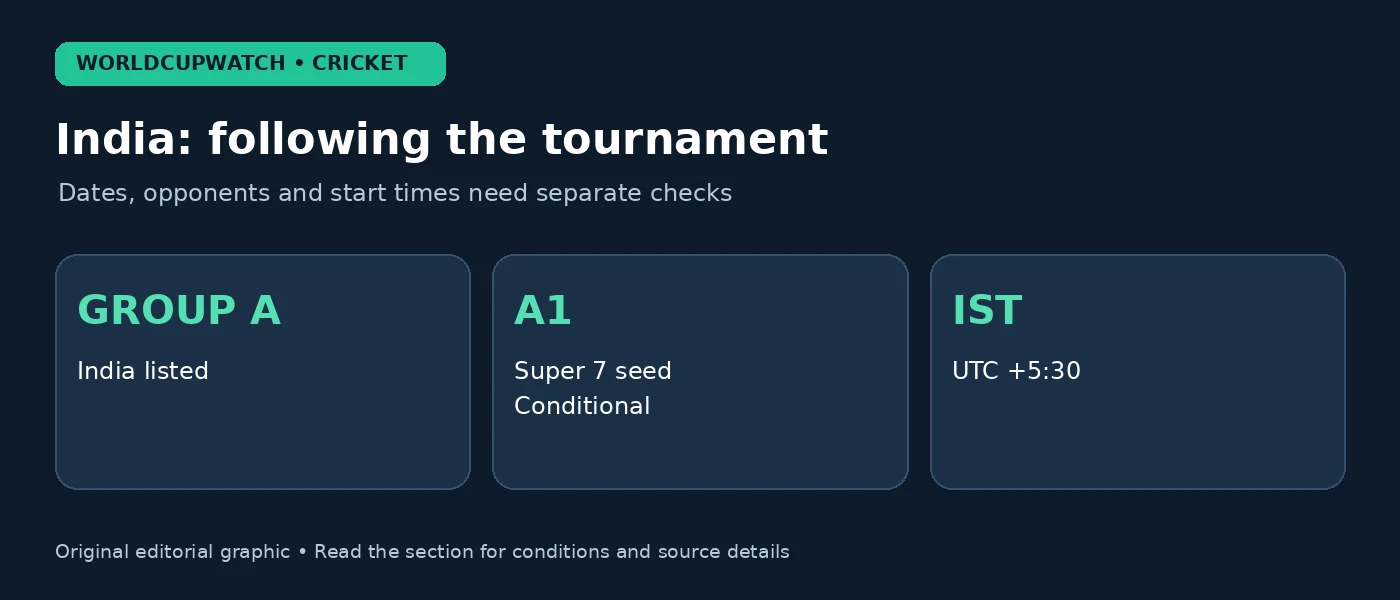
India is also listed in Group A. The ICC fixture list gives group games against Australia on 7 October, Pakistan on 10 October, Afghanistan on 14 October, Qualifier A on 17 October and Zimbabwe on 24 October 2027. Keep the qualifier label until the entrant is officially identified.
For Indian readers, an opening game against a strong opponent can provide valuable evidence, but one game is a small sample. Assess the method as well as the outcome. Was the innings paced well for the surface? Were wickets preserved at the cost of too many quiet overs, or was the scoring rate supported by manageable risk? Such questions tell more about readiness than an isolated final total.
Team balance also matters when conditions change during a long event. A likely XI should be examined for its roles, not merely its star names. Consider how batting depth, wicketkeeping, pace options and spin fit together. A selection that looks attractive in one setting might need a different combination elsewhere. Until official squads and match selections are available, any XI remains a projection.
A practical India match notebook can keep five items: the announced opponent, the venue, a verified time in IST, the match situation at a turning point and the final result. That gives enough structure to revisit a prediction honestly. If a forecast was wrong, distinguish a poor assumption from an unexpected event rather than quietly deleting the original assessment.
India Standard Time is UTC+5:30, or three and a half hours ahead of UTC+2 in the host countries. A hypothetical 10:00 local start would be 13:30 IST. India is also 30 minutes ahead of Pakistan, so two friends discussing the same game should name the timezone. An evening time copied without that label is easy to misread.
India and Pakistan fans will naturally focus on their meeting, but the wider group route deserves attention too. A team cannot choose to count only its biggest match. The practical consequence for readers is to follow the opponent mix, the remaining schedule and the applicable table before making an advancement claim.
The page does not promise that any established player will be selected for 2027. International careers, fitness and selection can change before the event. A dated player ambition or interview is useful background, but it is not an official squad list. We will distinguish confirmed selection from discussion of who might add value to the team.
Host countries, venue labels and conditions
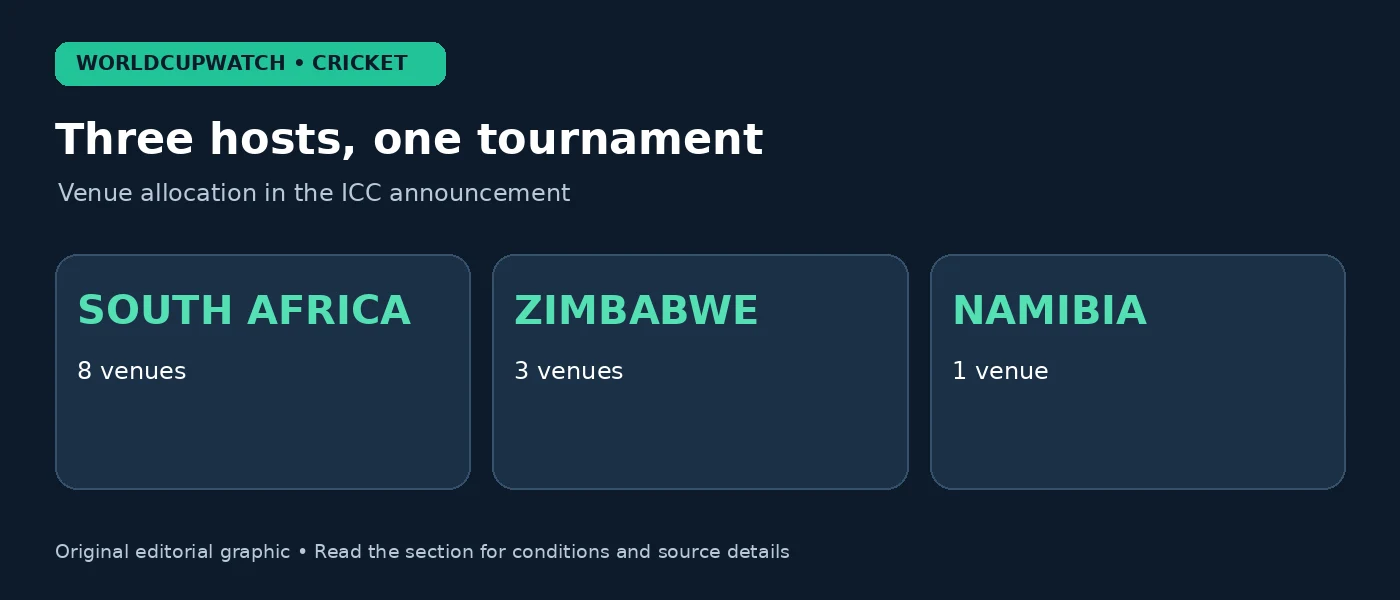
The ICC allocation uses eight venues in South Africa, three in Zimbabwe and one in Namibia. Its venue overview names Windhoek; Harare, Bulawayo and Victoria Falls; and South African cities including Cape Town, Johannesburg and Tshwane. The opening Super Series is in Windhoek, while Johannesburg is scheduled to host the final.
A host country is not the same thing as a single set of playing conditions. Ground dimensions, the prepared pitch, recent weather and the match-day surface can vary. A sensible preview uses evidence from the actual venue once it is relevant. Avoid attaching one stock description to every African ground and using it as if it settles the result.
Even historical venue data needs a careful reading. Ask whether it comes from ODI internationals, a domestic competition or T20 matches. Those samples are not interchangeable. A team’s willingness to attack a short-format target does not automatically tell you how it will build a 50-over innings. State the format and period when citing a trend.
The same caution applies to averages. A small number of matches, a changing pitch or an unusually strong visiting side can distort an apparently simple number. Rather than treating an average score as the target everyone must reach, use it alongside the current match conditions. A below-average total can still be competitive in the right circumstances.
For travel planning, pair the city with the ground name. An area or metropolitan label can appear differently across a schedule and a match listing, while the ground itself is the practical destination. Before booking accommodation, check the precise venue, transport route and confirmed fixture rather than relying on the tournament’s host-country list.
Our original illustrations on this page explain the topics; they are not photographs of future matches, stadium inspections or team training. Venue imagery and event photographs will be identified accurately when used. A picture of an unrelated cricket ground would not establish anything about the 2027 host venue.
There is a source conflict worth preserving: parts of ICC’s launch prose differ from the detailed fixture list on a South Africa opening game and a Zimbabwe venue description. We use the dated fixture list for the group dates above and advise checking the latest ICC match listing before travel. A conflicting official description should prompt a check rather than an invented reconciliation.
Who is favourite for Cricket World Cup 2027?

Our provisional editorial shortlist is India, Australia and South Africa, with no reliable numerical ordering at this stage. This is an early assessment, not betting odds, an ICC forecast or a claim that the champion is already known. Australia is the defending ODI champion; South Africa has host familiarity; India is a central contender in the published draw. Those starting points justify questions, not certainty.
A favourite should be a team with several credible ways to win, rather than one that needs its preferred scenario every time. We will look for an innings plan when early wickets fall, a bowling plan when the pitch offers little help and reliable execution late in a close game. The best early case is built from that range of responses.
For India, our key test is the durability of the selected batting and bowling combinations across different ODI situations. For Australia, the question is whether the confirmed squad can reproduce a balanced tournament campaign rather than living on the reputation of a previous title. For South Africa, it is how familiarity with home settings translates into specific, repeatable match plans.
Pakistan and New Zealand belong in the next part of our watchlist, while England, Sri Lanka, Afghanistan and Bangladesh need current ODI evidence considered on their own terms. This is not a fixed ranking of those teams. A sharp change in form, availability or balance can alter the assessment, and we will not manufacture percentage chances without a validated model.
Kagiso Rabada offered a useful player perspective in ICC’s 9 August 2026 interview: we’re at home and we’re going to defend this fortress
. Read the ICC interview with Rabada for the context. It is a dated expression of confidence, not independent proof of South Africa’s winning probability.
There is room for a supporter to favour a team emotionally while recognising the limits of an analytical forecast. If you want a useful assessment, ask what evidence would change it. A preview that cannot identify a possible weakness is closer to promotion than analysis. We will revisit this shortlist nearer the tournament using ODI results, confirmed personnel and the actual venue information.
Match favourites and tournament favourites should also be kept separate. A side could be well suited to one opponent without having the depth to navigate an entire event. Conversely, a strong tournament team can face an awkward individual matchup. That distinction is why our later match previews will explain their own reasoning instead of copying the hub’s early shortlist.
How our predictions will be built and reviewed
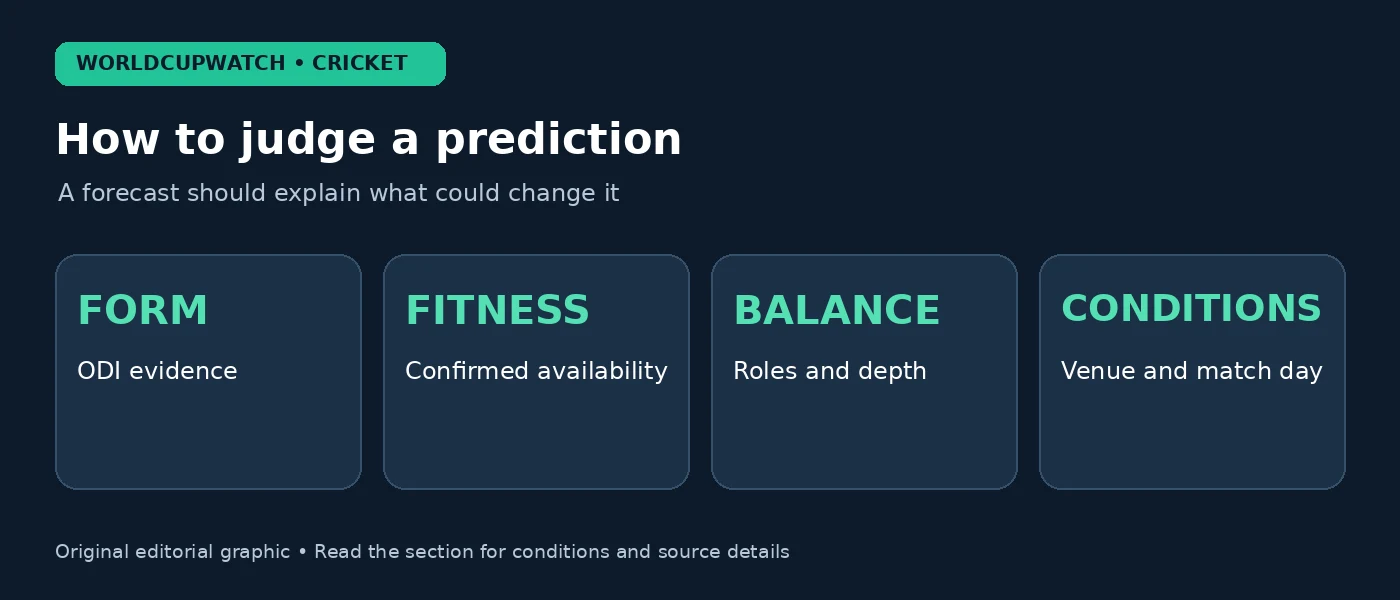
Our predictions will separate three layers: verified information, an interpretation of that information and the forecast itself. A confirmed injury belongs in the first layer. An assessment of how the absence affects the attack belongs in the second. Selecting a likely winner belongs in the third. Keeping those layers visible helps readers decide whether they agree with the reasoning.
First, establish the format and the available players. ODI cricket rewards different pacing from a short-format league. A useful preview should account for a longer innings, changes in the ball and opportunities to recover after an early setback. Current selection and availability are more relevant than a famous player’s historical reputation.
Second, compare roles rather than merely comparing totals. One batter’s high average might come from a different job in the innings than another’s. A bowler who takes wickets with a new ball is being asked a different question from a bowler protecting the last few overs. Explain the role and match phase before declaring that one number proves superiority.
Third, use conditions with restraint. A toss prediction is not an announced toss result, and a weather possibility is not an interruption that has occurred. Write the conditional version: if the game has a reduced allocation, reassess the innings plan. When the actual toss and teams become known, update those parts rather than retaining an obsolete assumption.
Fourth, present the route to either result. In a hypothetical preview, Team A might be preferred if its top order can keep wickets in hand. Team B’s route could be taking early wickets and restricting scoring options later. That is a useful matchup explanation without invented player quotes, fabricated injury reports or a guaranteed outcome.
Finally, preserve the forecast’s date and review it after the match. If a predicted winner loses, ask which assumption failed and whether the evidence was reasonable at the time. The purpose of a review is to improve the analysis, not claim that every surprise was secretly anticipated. Transparent forecasts are more useful to readers than an unbroken record of edited hindsight.
A player or commentator’s opinion can add a perspective when its original post or interview is verified. We will identify the person, date and context and link the specific X post. Their expertise is a reason to consider the assessment, not a reason to turn a prediction into a result or an official selection announcement.
Points tables, tie-breaks and net run rate
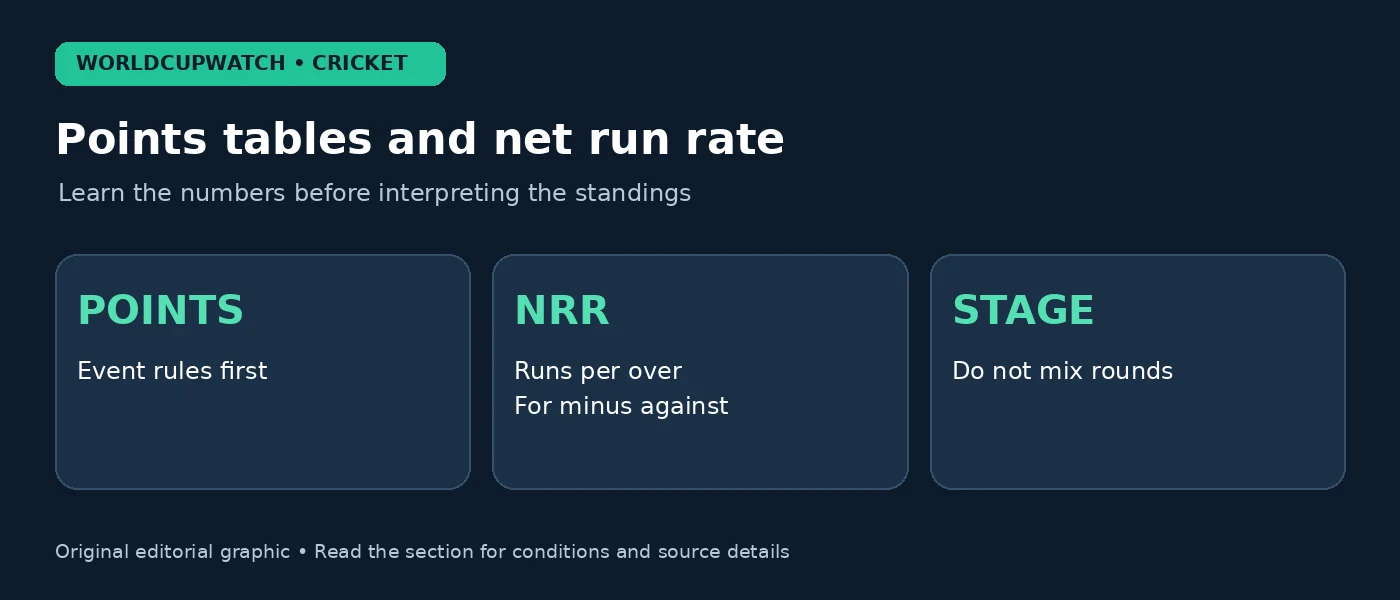
A points table is a record of a defined stage. Before interpreting one, look for the competition name, round, update time and matches played. The ordering should follow that event’s rules. A table without those details can be mathematically correct yet still misleading if the reader assumes it is live or belongs to a different round.
Net run rate compares the rate at which a side scores with the rate at which it concedes. Our net run rate calculation guide works through complete innings, early chases, scorecard overs and all-out examples. Use it to understand the arithmetic, then check the 2027 event’s conditions for its exact application.
As an original simplified example, a side making 180 in 20 overs and conceding 160 in 20 has a difference of one run per over. That is +1.000 for this example. It does not mean it has a 100 per cent chance of advancing, nor does it describe the team’s ODI World Cup outlook. An arithmetic measure and a forecast answer different questions.
A common reading error is to calculate a match figure and average it with another match’s figure. Tournament NRR generally needs the combined eligible runs and overs, with the prescribed adjustments. Different innings lengths mean an average of match rates can give a different result. Work from the scorecards and retain full precision until the final display.
Do not introduce a made-up points allocation or cross-group tie-break rule into this hub before the applicable 2027 playing conditions establish it. The broad progression route is announced, but detailed comparisons can require further rules. A reader should be able to tell which parts are settled and which need the event document.
For the fourth-place comparison, points and any equal-points criteria deserve particular attention once the rules are published. A team sitting fourth in its own group should not be marked through just because its fans expect it to be better than the other fourth-placed side. Show the actual relevant comparison with its source and time.
When a table is updated, compare the results that changed and the games still remaining. A move up or down can reflect other teams completing their matches rather than a sudden change in playing strength. Read the update date with the stage label, and use completed tables as records of a finished round rather than as current standings.
Tickets, start times and watching from your country
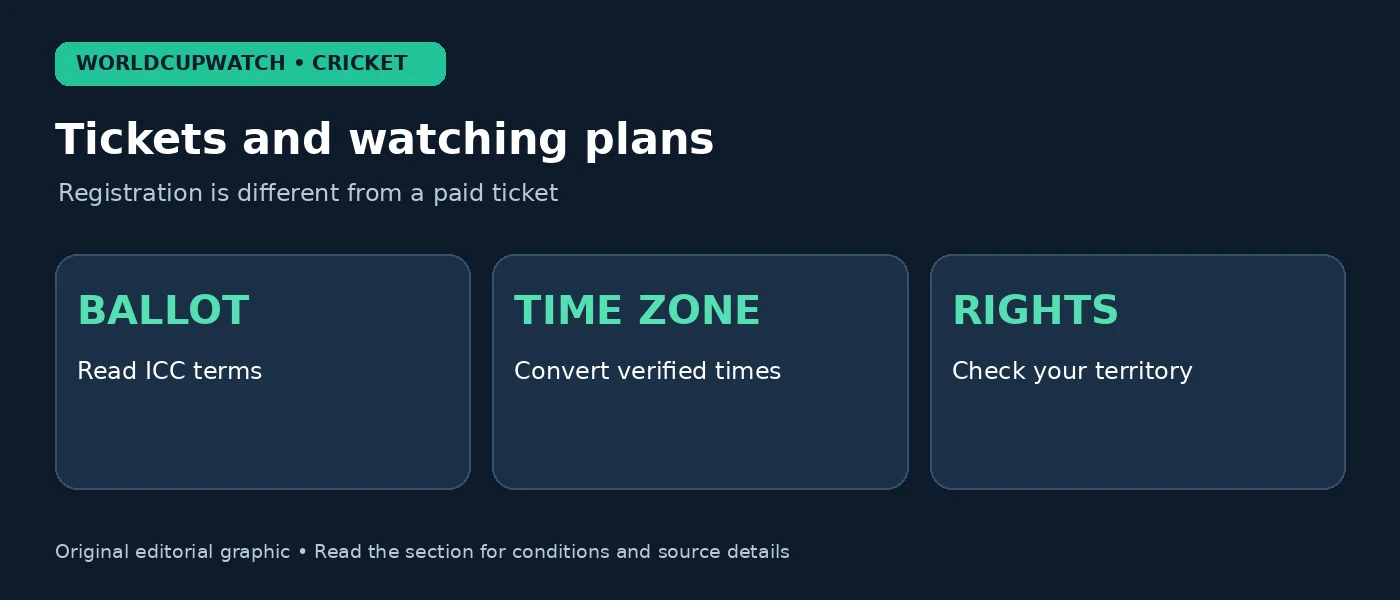
The ICC launch announcement describes a ticket ballot rather than a first-come purchase queue. It says registration is free and that the ballot window closes at 23:59 South African Standard Time on 21 November 2026. Successful applicants receive purchase information separately. Entering the ballot should not be described as having bought or guaranteed a ticket.
Use the ICC ballot explanation to reach its official next step. This page links to ICC rather than inserting a third-party seller. Recheck current terms before submitting details, particularly if you are looking at a saved article or a shared screenshot whose information may have changed.
Plan in stages: identify the match you want, establish whether the teams are confirmed or conditional, check the ticket process and then consider travel. A named team in a possible later-round slot does not eliminate the qualification condition. Flexible planning may be sensible when attendance depends on a team advancing, but that is a personal decision rather than a sporting guarantee.
For watching from Pakistan or India, territorial broadcast access needs its own verification. One event’s rights holder is not automatically the broadcaster for another year, another country or another format. We will add an access guide when current official information can establish the relevant territory and service. A claim of free streaming should include the actual eligibility and availability.
Start-time conversion is straightforward only once the original time is confirmed. PKT is three hours ahead of UTC+2 in the host countries; IST is three and a half hours ahead. Bangladesh is four hours ahead, Sri Lanka three and a half, and UAE two. UK readers should use the offset for the date because seasonal clock changes affect the comparison.
Be cautious around midnight. A host-local time converted eastwards can fall on the following calendar date. Include both date and timezone in a saved reminder rather than only an hour. If you share the fixture with another reader, specify whose local date is being used. This is particularly useful for supporters travelling or discussing the same game from different countries.
A final check before making a purchase should compare the event name, fixture identity, venue and latest official date. Keep a confirmed ticket distinct from a ballot entry and a provisional travel plan. This checklist is intended to help fans avoid practical confusion; it does not replace the official ticket terms or a travel provider’s conditions.
Latest qualification news and dated player references

7 October 2026: USA won the League 2 title after beating Namibia by four wickets in Dallas. ICC reported Monank Patel’s 108 as USA chased Namibia’s 298/9 with seven balls left. USA already had a Qualifier place. Winning League 2 does not itself establish a World Cup group-stage berth. The ICC match report is the source.
This is a meaningful development for readers following the wider field because it identifies a successful step on the road to the event. It belongs in the qualification timeline rather than being presented as confirmation of the remaining World Cup names. Read our USA League 2 news and qualification explainer for the confirmed result and the next hurdle.
16 May 2026, background rather than breaking news: ICC’s original X post about Virat Kohli’s 2027 focus described the World Cup as being on his mind. That reference helps establish the topic of the discussion; it does not confirm selection, a retirement date, a promised result or a fresh October statement.
Rabada’s August interview, linked in the favourites section, provides another dated player perspective. A current launch or result can sit alongside older background if both dates are visible. The danger comes from removing the date and making the background look like an immediate reaction to a different story.
For future X references, the original status link is the important identifier. A screenshot can crop the date or miss surrounding context, while a repost can change the framing. We will not use an automated trending summary as if it were a player’s words. Where the original post cannot be verified, its supposed quote will stay out of the published story.
The latest-news area is meant to answer what changed, when it happened and why it matters to the qualification or tournament story. A short, sourced update can be more useful than repeating an entire hub every day. A detailed match report should add the turning points and sporting context; a news update should make the confirmed change easy to understand.
A commentator’s selection preference will be labelled as a preference. A player’s statement about ambition will be labelled as ambition. An ICC member’s official decision needs the actual announcement. Those distinctions allow the page to include strong voices without making readers guess whether a statement is reporting, analysis or an official rule.
Questions about qualification, favourites and the schedule
Is the 2027 competition an ODI or T20 World Cup? This page covers the men’s ODI World Cup. Use the full event name when looking up a fixture, because international cricket has several competitions with similar names. A short social caption saying only “World Cup” can omit the information you need.
Are all 14 participants in the group stage? No. The opening Super Series determines which of three participants advances, leaving 12 group-stage sides. The explanation above distinguishes entry into the event from direct entry into the groups. It is the clearest way to read a qualification headline.
Does a seeded fixture confirm that India or Pakistan has advanced? No. A named seed is a schedule position subject to qualification. A possible later game should remain conditional until advancement and the final match listing establish the participants. That matters both for previews and for supporters making plans.
Who is our early favourite? We shortlist India, Australia and South Africa without a validated percentage or a fixed numerical order. It is our provisional editorial assessment. Confirmed squads, ODI evidence and match conditions will determine the later review. A favourite is still capable of losing a knockout.
Why do we avoid projected playing XIs here? The event is a year away at this update. A guessed XI can quickly become stale as availability and selection change. We prefer discussing the roles needed, then evaluating an official squad and match team when those decisions exist.
Do we have confirmed first-ball times for every match? This guide does not claim them. It provides announced dates and time-zone guidance. Before setting a reminder, verify the latest ICC match time and convert that specific time rather than borrowing the start of a similar previous game.
Can an X post confirm a team selection or qualification? An authentic official announcement can be relevant evidence, but a commentator’s opinion or a player’s hope cannot settle those facts. Read the account identity, exact statement and date together. Our dated Kohli link is background, not a squad announcement.
What is the quickest way to use this long guide? Start at the answer you need using the contents links. Then follow the related source or supporting guide if you need detail. You do not need to read every section to establish a date or understand a qualification route; the longer analysis is there for readers asking why it matters.
Official sources, related guides and corrections

The factual spine of this page comes from ICC’s dated schedule, qualification and format announcements. Those documents answer different questions. The fixture list supplies dates and opponents; the launch explains entry routes and ticket procedure; the format overview explains the stages and conditional seeding. We link each near the point it supports so readers can inspect the evidence.
The favourites shortlist and the practical match-reading advice are WorldCupWatch analysis. They are not attributed to ICC or to a player. The original section illustrations describe the same concepts as the surrounding text and do not pretend to document future matches. Their key information is also available in the article, so an image is not the only place a reader can find an answer.
For more detail, read the worked net run rate guide, the current Pakistan schedule and the Cricket coverage hub. The Cricket Desk and Editorial Policy explain our publishing approach.
If a detail is wrong, please send the relevant ICC announcement or original X post through the contact page, with the specific fixture or claim in question. A clear source and date make it easier to correct the underlying issue rather than changing one line while leaving another contradictory line in place.
We will update this guide when there is a verified change to its facts or a meaningful revision to the assessment. A new source date will be recorded when the information is actually reviewed. An old opinion will retain its own date rather than being republished as a new statement. That gives returning readers a useful record of what is settled, what changed and what remains a prediction.